The Evolution of RWA Trading Onchain: Variational Swaps
RWA perp volume went from under $1 billion in October 2025 to over $120 billion in August. How Variational swaps compare with perps on funding and execution cost.
Castle Labs covers perpetual futures and onchain trading from the order book up. Our October 2026 report, Mapping the Perpetual Trading Ecosystem, compares Hyperliquid, Lighter, Variational, TradeXYZ, Ondo, QFEX, edgeX, Extended, Pacifica, GMX and Jupiter on design, liquidation backstops, token value accrual, turnover and take rate, then tests execution cost, depth, funding and index quality against Binance, Bybit and OKX with live order-book data. The same lane covers RWA and pre-IPO perps, options, funding-rate markets, prediction markets and our tick-by-tick comparison of Hyperliquid oil perps with CME WTI futures.
Sources: Hyperliquid Info API (2026-11-01), DeFiLlama prediction markets (2026-11-01), DeFiLlama options volume (2026-11-01).
Onchain perp venues by open interest and 24h volume, with a Binance comparison
Hyperliquid's daily, weekly, monthly and 12-month revenue, its sources and the HIP-3 share
The chance Bitcoin reaches $100K by year-end, from Deribit options and Polymarket, with the implied price range
A comparative analysis of perp trading venues across design, GTM and microstructure
State of Commodities and a Quantitative Analysis of the Growth of these Markets Onchain
Mapping the expansion of options as a trading instrument and the volatility that prices them
RWA perp volume went from under $1 billion in October 2025 to over $120 billion in August. How Variational swaps compare with perps on funding and execution cost.

Hyperliquid's CL oil perp vs CME WTI futures over 432 hours: CME shows 125x more depth at 2 bps, and median trades differ 166x, $90,450 vs $543.

Key takeaways from Jeff's interview on Hyperliquid: the HYPE airdrop, why there is no discretionary buyback program, HIP-3 markets and TradeXYZ's silver volume.
Hyperliquid held over 56% of onchain perp open interest in September 2026, followed by Aster (9.7%), Variational (6.2%) and Lighter (5.7%). Onchain venues now handle over 13% of all perp volume, up from 4% in 2024.
For crypto majors, often yes once fees are counted. In our September 2026 test at $100,000, Hyperliquid was 1% to 24% cheaper to trade than the Binance, Bybit and OKX median across BTC, ETH, SOL, ZEC and HYPE, and Lighter was over 60% cheaper because it charges no taker fee.
RWA perps reference markets that close. Venues handle off-hours with discovery bounds, internal order-book pricing or hard price limits, so on weekends venue indices can diverge by up to 30 bps and funding can become the main cost of holding. RWA perps reached $123 billion in volume in August 2026.
The research covers order books, AMMs, perpetual options, short-dated binaries, volatility surfaces, and the overlap between options and prediction markets.
Funding-rate products separate the cost of holding perpetual exposure from the asset price itself, giving traders a direct market for rates, basis, and relative-value strategies.
Showing 1-12 of 19 articles
Page 1 / 2
Liquidity Providers (LPs) on Decentralised Exchanges (DEXs) have long faced a structural problem during market movements: as prices move on Centralised Exchanges (CEXs), which are hubs for spot liquidity and perform price discovery, DEXs still quote prices before the market moves, giving arbitrageur

This excerpt is from our research on Mapping the Perpetual Trading Ecosystem: A Comparative Analysis of Perp Trading Venues across Design, GTM and Microstructure, highlighting the perp ecosystem, including the key growth enablers, the architecture on which the protocols are built, and the GTM strate

Onchain options in three families: Derive and Paradex order books, binary markets on Polymarket, Kalshi and HIP-4, and option yield products from Rysk and Hegic.

Prediction markets work like binary options, down to 300-second expiries. How Polymarket, Kalshi and Hyperliquid binaries compare as option-like instruments.
A Gap Analysis with Interviews from Rysk, Derive, Panoptic, and GammaSwap.

Options traded over 4x the contracts of futures in 2024. How onchain options moved past DOVs to order books, AMMs, perpetual options and short-dated binaries.
How propAMMs differ from passive x*y=k AMMs, why their fills on Solana landed 0.33 to 1.36 bps from the best CEX mid, and how the model is growing on Ethereum.

Castle Labs research on Boros, Pendle’s yield-trading platform for funding rates, covering Yield Units, hedging use cases, vaults, liquidity, and power-user strategies.

How HIP-4 brings binary prediction markets to Hyperliquid, challenging Kalshi and Polymarket, and how much HYPE buyback revenue it could add at 3 to 4 bps fees.

How Almanak's Strategy Builder uses an AI agent swarm to turn ideas into deterministic, verifiable trading code, tested by building a Pendle RSI strategy.
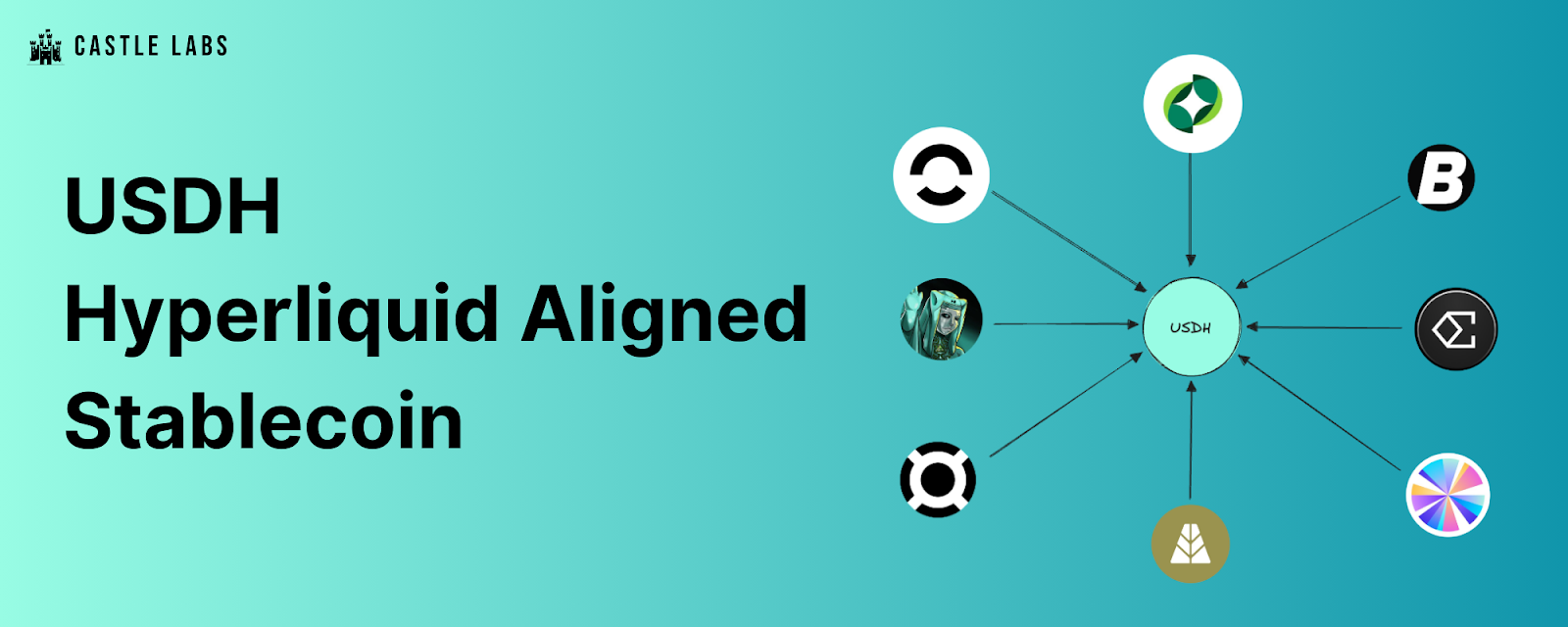
USDH proposals compared: Paxos, Frax, Native Markets, Agora, Sky, Ethena and others bid for Hyperliquid's native stablecoin, as 95% of its $5.8B supply is USDC.

Crypto AI weekly: Theoriq and Almanak raise via Kaito and Legion, and how Rei Network's Core synthetic brain tackles LLM memory, stale data and hallucinations.
Castle works with protocols, investors, and market teams on category research, competitive analysis, and distribution.