Research/Flagship Reports
Published October 202681 pagesNoveleader · Francesco

Mapping the Perpetual Trading Ecosystem

A comparative analysis of perp trading venues across design, GTM and microstructure

Data snapshot: September 2026. Figures are preserved from the published report; charts marked updated daily use live data.

“Perps have shifted from venues offering leveraged exposure to underlying assets to venues offering price exposure to previously unavailable assets.”

▮ The numbers that matter

$15.18B
Record open interest across onchain perp venues
56%+
Hyperliquid share of onchain perp open interest
13%+
Share of perp volume on DEXs, up from 4% in 2024
$123B
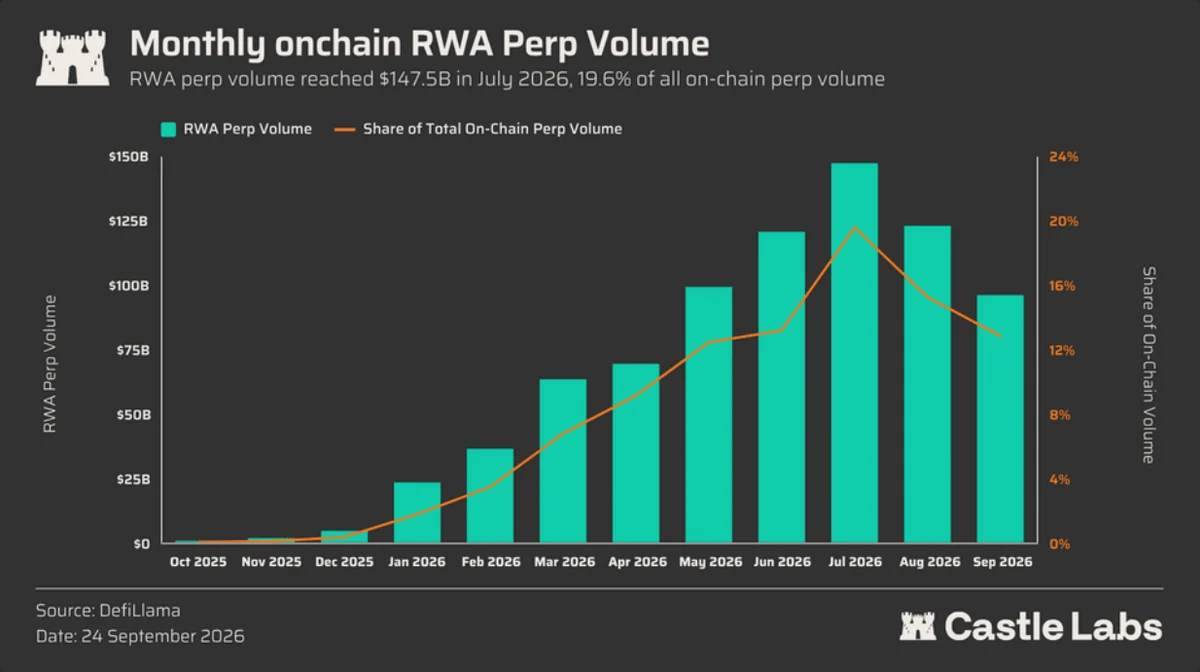
RWA perp volume in August 2026
3.7 bps
Hyperliquid median slippage on a $1M crypto order
261+
Perp DEXs launched since Hyperliquid

Executive Summary

Onchain perps are at a record $15.18 billion in open interest, and DEXs now handle over 13% of perp volume, up from 4% in 2024. The report maps the venues behind that growth across pooled liquidity, high-performance order books, RWA and TradFi perps, prediction-market perps and trading terminals, then compares turnover, take rate, execution cost, depth, funding and index quality across Hyperliquid, Lighter, Variational, TradeXYZ, Ondo, QFEX, Entropy, Binance, Bybit and OKX.

Key findings

  1. 01Hyperliquid holds over 56% of onchain perp open interest, followed by Aster (9.7%), Variational (6.2%) and Lighter (5.7%), and more than 261 perp DEXs have launched since Hyperliquid.
  2. 02RWA perps have grown more than 100x since October 2025 to $123 billion in August 2026 volume, and TradeXYZ and Variational account for 90% of it.
  3. 03At $1 million, Hyperliquid had the lowest median slippage of the five venues tested on crypto majors, 3.7 bps against 3.8 bps on Binance, and after fees it was 1% to 24% cheaper to trade than the centralised median. Lighter was over 60% cheaper because it charges no taker fee.
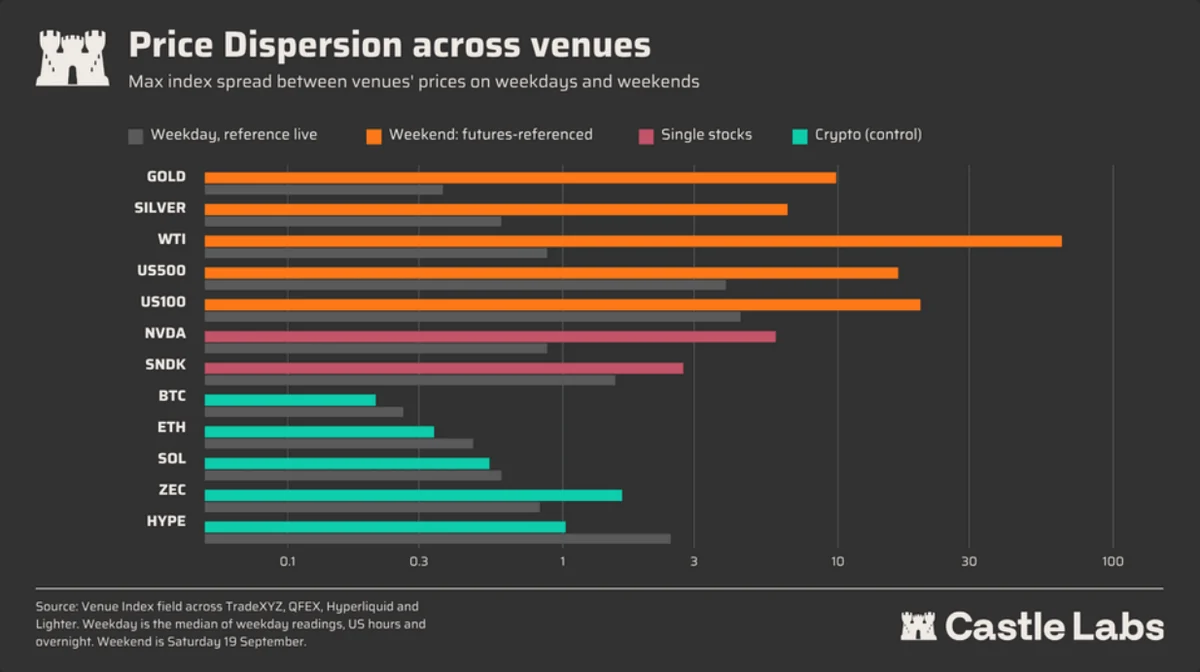
  4. 04For TradFi perps at $100,000, TradeXYZ had the tightest spread (0.35 bps) and Lighter the lowest cost to open (1.04 bps). On weekends, venue indices diverged by up to 30 bps and Lighter's WTI funding reached +95% a year for longs.
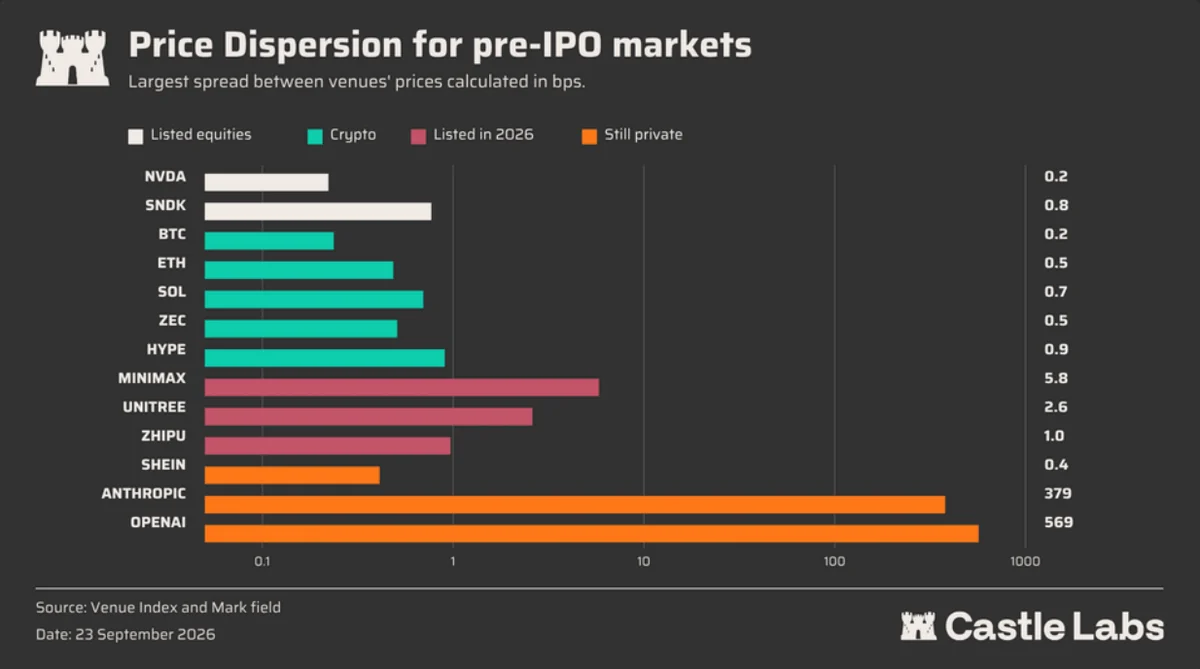
  5. 05Pre-IPO perps on Anthropic and OpenAI are the thinnest markets measured: venue prices differed by 379 and 569 bps, no venue held more than $160,000 within 10 bps of mid, and holding a long cost from about 1% to 33% a year depending on the venue.

Covered in the report

HyperliquidLighterVariationalTradeXYZedgeXExtendedPacificaGMXGMTradeJupiter PerpsOndo PerpsQFEXEntropyIOKalshiPolymarketTreadFiBinanceBybitOKX

Inside

  1. 01Executive Summary
  2. 02Growth of Onchain Perps
  3. 03The Hyperliquid Boost
  4. 04Pooled Liquidity Perps
  5. 05High-Performance Order Books
  6. 06RWA and TradFi Perps
  7. 07Prediction Market and Regulated Perps
  8. 08Trading Terminals and Infrastructure
  9. 09Comparing the Venues
  10. 10Perps GTM and Post-TGE Strategy
  11. 11Microstructure: CEXs vs DEXs
  12. 12Microstructure: DEXs vs DEXs
  13. 13Conclusion

What Is a Perp DEX?

A perp DEX is an onchain exchange for perpetual futures: leveraged contracts that track an asset's price and never expire. Instead of settling on a date, a perp uses a funding rate, paid between longs and shorts, to keep the contract price close to the underlying index. Traders keep custody of their collateral and positions settle onchain.

Perp DEXs now handle over 13% of perp volume, up from 4% in 2024, and onchain perp open interest reached a record $15.18 billion. More than 261 perp DEXs have launched since Hyperliquid. Most use one of three designs.

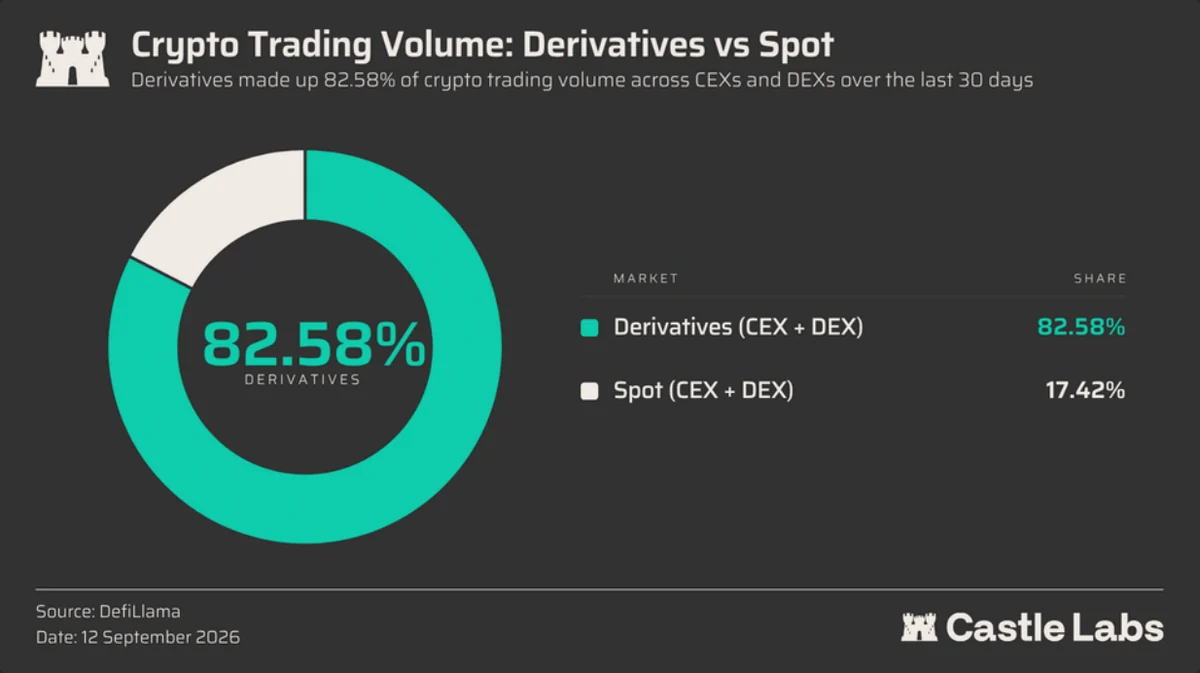
Crypto trading volume: derivatives vs spot. Derivatives made up 82.58% of crypto trading volume across centralised and onchain venues over 30 days. On most major venues, perp trading is 4.7x spot.

Crypto trading volume: derivatives vs spot

Derivatives made up 82.58% of crypto trading volume across centralised and onchain venues over 30 days. On most major venues, perp trading is 4.7x spot.

Report page 6

The three main perp DEX designs

DesignHow it worksExamples
Pooled liquidityTraders trade against a shared liquidity pool rather than another trader. This was the category's first model.GMX, GMTrade, Jupiter Perps
High-performance order bookA dedicated appchain or rollup runs a CEX-style order book at CEX speed while users keep self-custody.Hyperliquid, Lighter, edgeX, Pacifica
Request for quote (RFQ)The trader requests a price, a market maker quotes it, and the trade is booked in an isolated settlement pool. There is no order book.Variational

Source: Castle Labs, Mapping the Perpetual Trading Ecosystem (October 2026)

Hyperliquid vs Lighter vs Variational

The three venues take different routes to the same market. Hyperliquid has the deepest book, Lighter is the cheapest to trade on standard orders, and Variational quotes prices instead of running an order book.

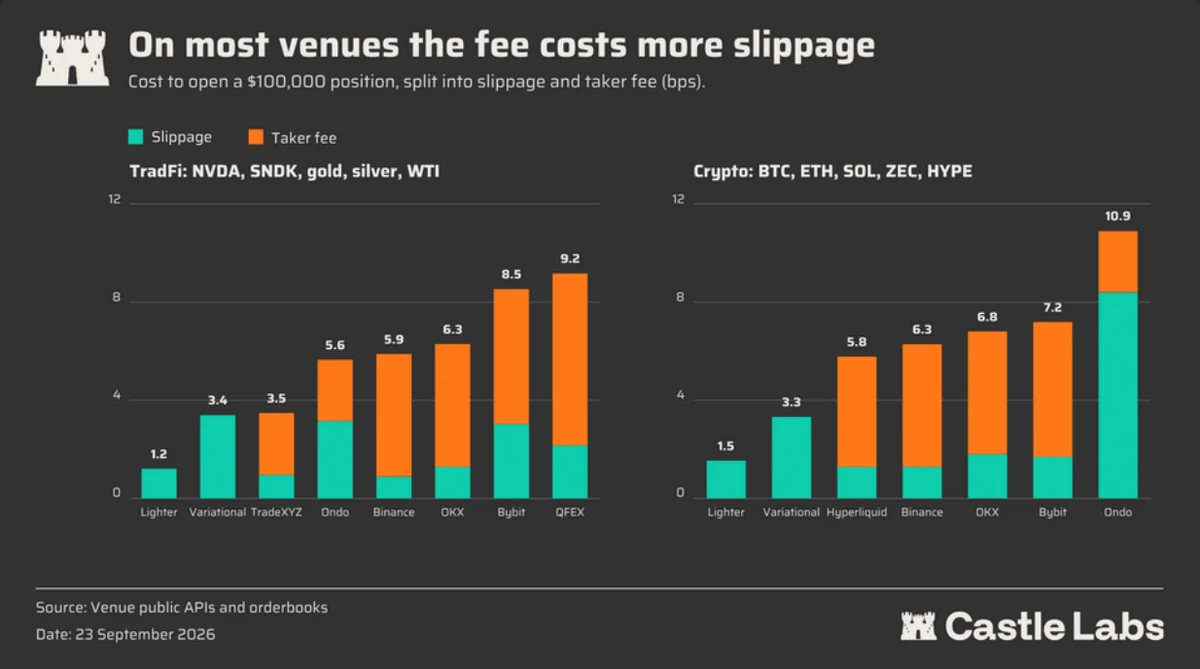
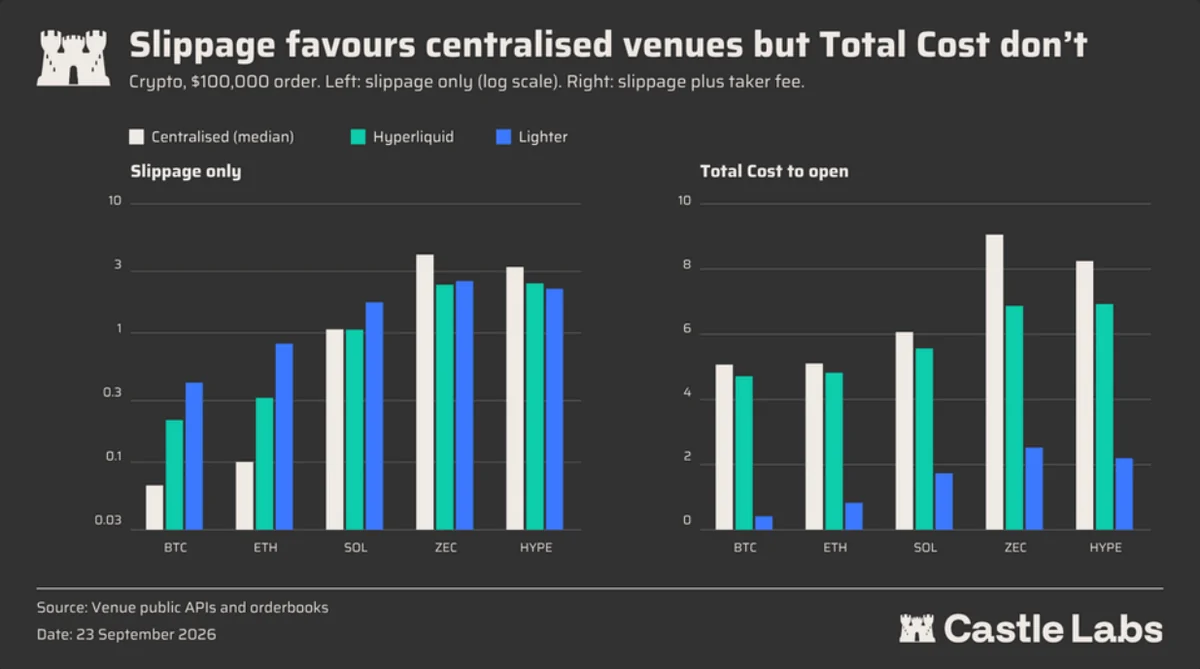
Cost to open a $100K position: slippage vs taker fee. A 5 bps taker fee on a $100K BTC order costs $50, about 75x the slippage. Hyperliquid was 7% to 24% cheaper than the centralised median on BTC, ZEC and HYPE; Lighter was over 60% cheaper with no taker fee.

Cost to open a $100K position: slippage vs taker fee

A 5 bps taker fee on a $100K BTC order costs $50, about 75x the slippage. Hyperliquid was 7% to 24% cheaper than the centralised median on BTC, ZEC and HYPE; Lighter was over 60% cheaper with no taker fee.

Report page 66

Hyperliquid, Lighter and Variational compared

Volume, open interest and turnover are averages from 17 August to 15 September 2026. Cost to open is slippage plus the standard taker fee on a $100,000 BTC order; Variational was not part of the crypto execution test.

HyperliquidLighterVariational
DesignOrder book on its own L1, secured by HyperBFTOrder book on an app-specific ZK-rollup with an Ethereum escape hatchRFQ with no order book; the Omni Liquidity Provider (OLP) is the only maker
Share of onchain perp OI56%+5.7%6.2%
Avg daily volume$7.90B$1.80B$1.29B
Avg daily open interest$6.79B$629.4M$772.9M
Turnover1.16x a day2.87x a day1.66x a day
FeesTaker fee; 2.6 bps take rateNo fee on standard accounts; 1 bp on advanced order types; 0.8 bps take rateNo maker or taker fees; earns from the spread
Cost to open, $100k BTC4.71 bps0.41 bpsNot tested
Liquidation backstopHLP vault, then auto-deleveragingLighter Liquidity Pool (LLP) vaultsIf OLP is liquidated, affected users receive the liquidation penalty
TokenHYPE; 90% of USDC reserve yield routed to buybacks via AQAv2LIT, launched December 2025; fee-funded buybacks and burnsPoints program ahead of its token launch

Source: Castle Labs, Mapping the Perpetual Trading Ecosystem (October 2026)

In short: Hyperliquid suits size on crypto majors, with the lowest median slippage at $1 million of the five venues tested, Binance included. Lighter suits cost-sensitive traders on standard orders because it charges no taker fee. Variational suits RWA trading with size, where its slippage barely rose as orders grew, and its swaps charge a daily carry fee instead of funding.

Best Perp DEXs by Open Interest

Open interest is the clearest single measure of where traders keep capital. The table below ranks perp DEXs by current open interest and updates daily from DefiLlama. In the report's September snapshot, Hyperliquid held over 56% of onchain perp open interest, followed by Aster (9.7%), Variational (6.2%) and Lighter (5.7%).

Open interest is only half the picture. Turnover shows whether that capital trades or churns: QFEX, Hyperliquid and Variational turn over less than 2x a day, while Jupiter Perps, Pacifica and GMTrade trade 7x to 9x their open interest daily, consistent with points programs and airdrop farming.

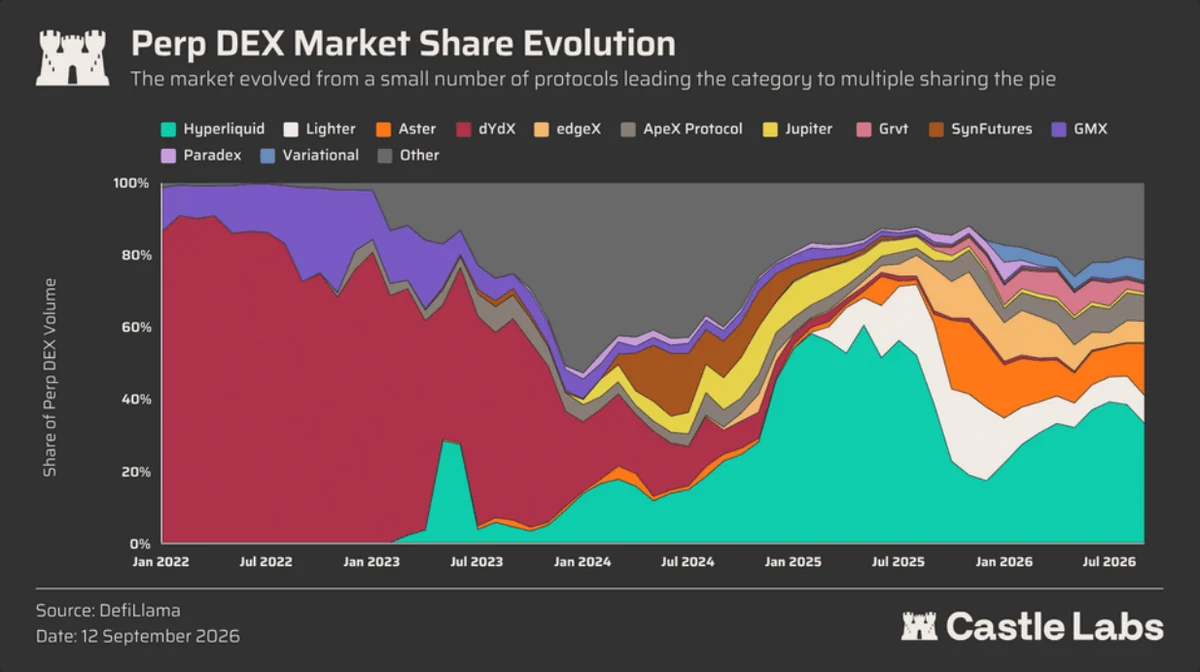
Perp DEX market share over time. The market moved from a few leaders, first dYdX and then GMX, to many venues sharing it. Hyperliquid has led since launch, apart from a short spell in November 2025 when Lighter took the top spot.

Perp DEX market share over time

The market moved from a few leaders, first dYdX and then GMX, to many venues sharing it. Hyperliquid has led since launch, apart from a short spell in November 2025 when Lighter took the top spot.

Report page 7

Top perp DEXs by open interest, 1 November 2026

Share of $13.17B tracked onchain perp open interest across 45 venues. Updated daily.

VenueOpen interestShare30-day change
1. Hyperliquid$7.45B57%-11%
2. Aster$1.41B11%-2.0%
3. Variational$905.1M6.9%-14%
4. Lighter$706.8M5.4%-14%
5. Grvt$416.9M3.2%-12%
6. Antarctic$337.9M2.6%-4.9%
7. GMX$246.8M1.9%-20%
8. QFEX$183.0M1.4%+33%
9. SoDEX$153.7M1.2%+32%
10. edgeX V2$131.9M1.0%-44%

Source: DefiLlama open interest overview

More Charts From the Report

11 charts from the 81-page PDF on this page, each with the number that matters.

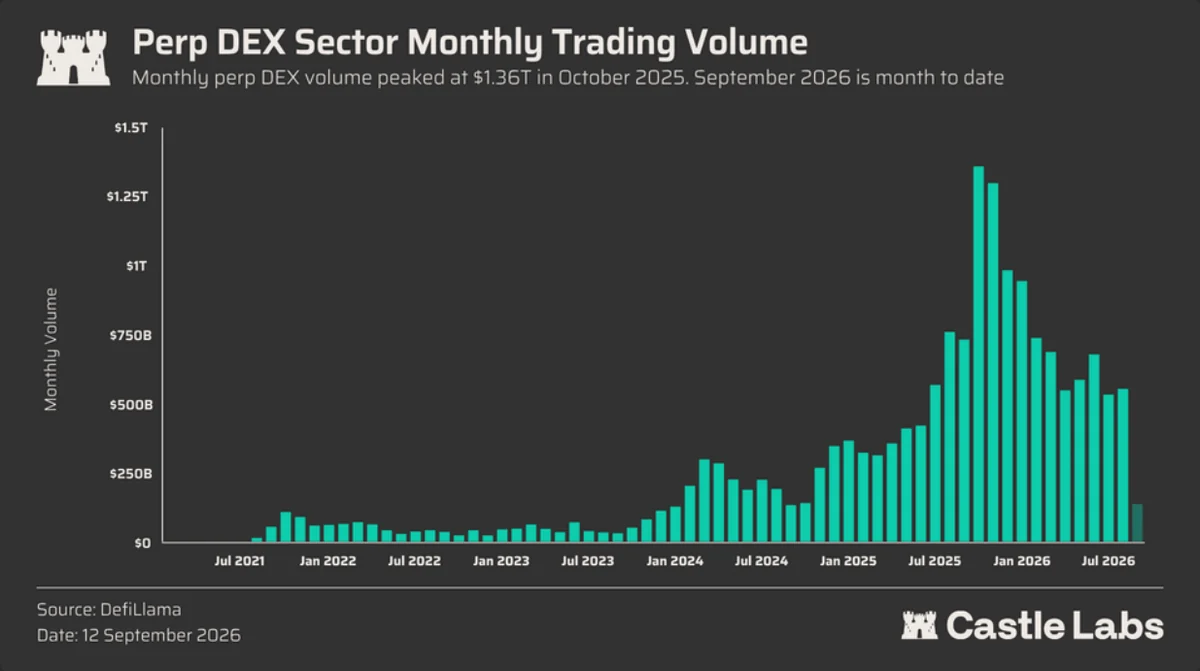
Perp DEX monthly trading volume. Monthly perp DEX volume peaked at $1.36 trillion in October 2025 and cooled through 2026.

Perp DEX monthly trading volume

Monthly perp DEX volume peaked at $1.36 trillion in October 2025 and cooled through 2026.

Report page 11

Monthly onchain RWA perp volume. RWA perps reached $147.5 billion of volume in July 2026, 19.6% of all onchain perp volume. At its peak, TradeXYZ's listings drove half of Hyperliquid's volume.

Monthly onchain RWA perp volume

RWA perps reached $147.5 billion of volume in July 2026, 19.6% of all onchain perp volume. At its peak, TradeXYZ's listings drove half of Hyperliquid's volume.

Report page 10

Perp DEX Open Interest by Protocol

Share of open interest across perp DEXs, 31 Oct 2026

Hyperliquid57.1%Aster10.6%Variational6.7%Lighter5.3%Grvt3.1%Others17.2%

Source: DefiLlama · Data to 31 Oct 2026 · Updated daily

Castle Labs
View the data
Share of open interest
Hyperliquid57.1%
Aster10.6%
Variational6.7%
Lighter5.3%
Grvt3.1%
Others17.2%

Now, 31 Oct 2026Perp DEX open interest: $13.26B · Hyperliquid share: 57.1%

In the report, September 2026Hyperliquid holds 56.8% of the $14.64 billion of open interest across perp DEXs, followed by Aster (9.7%), Variational (6.2%) and Lighter (5.7%).

Report page 10

Hyperliquid Builder Code Fees by Frontend

All-time builder code fees on Hyperliquid, ten largest frontends tracked by DefiLlama

Phantom$27.4MBasedApp$15.3MMetaMask$13.2Mpvp.trade$8MInsilico Terminal$4.2MTrust Wallet$4.2Mfomo$3.4MInfinex$2.8MRabby$2.6MLiquid$2.2M

Source: DefiLlama · Data to 1 Nov 2026 · Updated daily

Castle Labs
View the data
Builder code fees, all time
Phantom$27.43M
BasedApp$15.35M
MetaMask$13.17M
pvp.trade$8.02M
Insilico Terminal$4.17M
Trust Wallet$4.17M
fomo$3.44M
Infinex$2.84M
Rabby$2.61M
Liquid$2.18M

Now, 1 Nov 2026Phantom, all time: $27.43M · Ten largest frontends, all time: $83.39M

In the report, September 2026Phantom leads with 24.0% of the $109.57 million in all-time builder code fees paid to outside frontends.

Report page 17

Slippage vs total cost on a $100K crypto order. Binance, Bybit and OKX look far ahead on slippage alone. Add the taker fee, which is what a trader actually pays, and Hyperliquid and Lighter close most of the gap.

Slippage vs total cost on a $100K crypto order

Binance, Bybit and OKX look far ahead on slippage alone. Add the taker fee, which is what a trader actually pays, and Hyperliquid and Lighter close most of the gap.

Report page 64

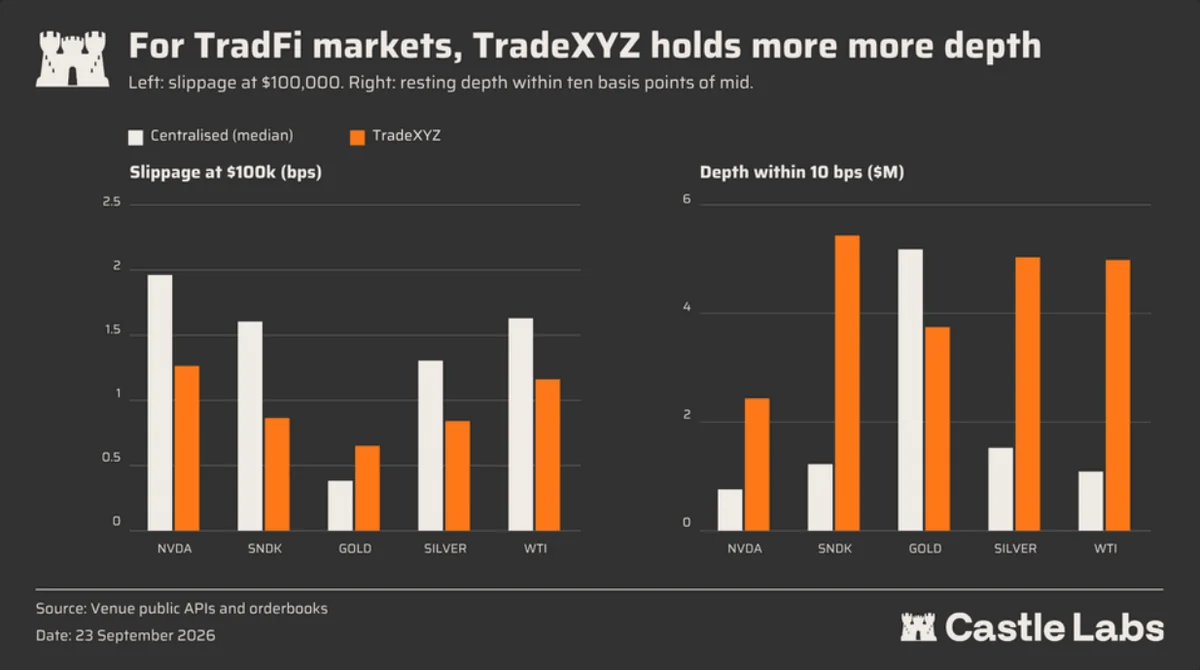
TradFi perps: TradeXYZ vs centralised venues. On TradFi assets, TradeXYZ holds more resting depth near the mid price, while Binance is tighter on slippage. For crypto, BTC funding already runs at 1.9% to 7.6% a year on every venue.

TradFi perps: TradeXYZ vs centralised venues

On TradFi assets, TradeXYZ holds more resting depth near the mid price, while Binance is tighter on slippage. For crypto, BTC funding already runs at 1.9% to 7.6% a year on every venue.

Report page 68

Price dispersion across venues: weekdays vs weekends. Crypto prices agree across venues all week. RWA prices drift apart at weekends, when the futures or equity markets they reference are closed.

Price dispersion across venues: weekdays vs weekends

Crypto prices agree across venues all week. RWA prices drift apart at weekends, when the futures or equity markets they reference are closed.

Report page 72

Price dispersion on pre-IPO perps. With no reference price, venues disagree by 379 bps on Anthropic and 569 bps on OpenAI, against 0.1 bps on NVDA. Holding an OpenAI long costs about 33% a year in funding; QFEX paid about 1%.

Price dispersion on pre-IPO perps

With no reference price, venues disagree by 379 bps on Anthropic and 569 bps on OpenAI, against 0.1 bps on NVDA. Holding an OpenAI long costs about 33% a year in funding; QFEX paid about 1%.

Report page 76

Get every chart in the full report →

Method and Data Boundary

Castle maps each venue's architecture, liquidation backstop and token value accrual, with interviews from the Lighter, Variational and Ondo teams. Turnover and take rate use DefiLlama volume, open-interest and fee series for 17 August to 15 September 2026. The microstructure analysis reads live order books, index and mark prices, funding and fee schedules from public APIs for Binance, Bybit, OKX, Hyperliquid, Lighter, TradeXYZ, Entropy, Ondo, Variational and QFEX at the same instant, every 45 to 60 seconds for 10 to 20 minutes per session, across crypto, TradFi and pre-IPO baskets, with TradFi split into weekday and weekend sessions. Execution cost is slippage plus the standard taker fee at $1,000, $10,000, $100,000 and $1 million. Depth is resting size within 10 bps of mid.

Published
October 2026
Data snapshot
September 2026

Data From the Report

Perp venue turnover and take rate

Average daily volume and open interest, 17 August to 15 September 2026. Turnover is average daily volume divided by average daily open interest; low turnover means traders hold positions, high turnover points to incentive or bot-driven churn. Polymarket and Kalshi perps are single-day readings from 15 September.

VenueAvg daily volumeAvg daily OITurnover (x/day)Take rate
QFEX$182.4M$217.6M0.84xNot tracked
Hyperliquid$7.90B$6.79B1.16x2.6 bps
Variational$1.29B$772.9M1.66xNot tracked
Polymarket Perps$94.6M$49.3M1.92xNot tracked
edgeX$1.38B$572.7M2.42x0.9 bps
GMX$86.9M$32.2M2.70x2.7 bps
Lighter$1.80B$629.4M2.87x0.8 bps
Ondo Perps$133.4M$46.1M2.89xNot tracked
Extended$258.9M$87.5M2.96x2.33 bps
Jupiter Perps$237.8M$34.8M6.83x3.7 bps
Pacifica$402.3M$48.5M8.30x3.0 bps
GMTrade$796.6M$90.6M8.79x0.4 bps
Kalshi$886.0M$30.7M28.86xNot tracked

Source: DefiLlama daily volume, open-interest and fee series

Crypto perps at $100,000: centralised median vs Hyperliquid vs Lighter

Cost to open is slippage plus the standard taker fee. The centralised figure is the median of Binance, Bybit and OKX.

AssetSlippage, CEXSlippage, HyperliquidSlippage, LighterCost to open, CEXCost to open, HyperliquidCost to open, Lighter
BTC0.07 bps0.21 bps0.41 bps5.07 bps4.71 bps0.41 bps
ETH0.10 bps0.32 bps0.83 bps5.10 bps4.82 bps0.83 bps
SOL1.07 bps1.06 bps1.73 bps6.07 bps5.56 bps1.73 bps
ZEC4.06 bps2.37 bps2.53 bps9.06 bps6.87 bps2.53 bps
HYPE3.24 bps2.43 bps2.20 bps8.24 bps6.93 bps2.20 bps

Source: Venue public APIs and order books, 23 September 2026

TradFi perps: cost to open at $100,000

Median across seven TradFi assets during US hours.

VenueSpreadSlippage at $100kAverage taker feeCost to open at $100k
TradeXYZ0.35 bps0.84 bps2.06 bps2.90 bps
Lighter0.65 bps1.04 bps01.04 bps
Ondo1.61 bps2.41 bps2.5 bps4.91 bps
QFEX3.32 bps2.40 bps6.43 bps8.83 bps
Variational4.66 bps2.82 bps02.82 bps

Source: Venue public APIs and order books, 23 September 2026

Questions This Report Answers

What is a perp DEX?
A perp DEX is an onchain exchange for perpetual futures, leveraged contracts that track an asset's price and never expire. A funding rate paid between longs and shorts keeps the contract close to the index price, and traders keep custody of their collateral. Perp DEXs now handle over 13% of perp volume, up from 4% in 2024, and the largest is Hyperliquid.
Which perp DEX has the most open interest in 2026?
Hyperliquid. In our September 2026 data it held over 56% of onchain perp open interest, followed by Aster (9.7%), Variational (6.2%) and Lighter (5.7%). Hyperliquid's own open interest reached a record $9 billion, on roughly $180 billion to $250 billion of monthly volume through 2026. Its turnover of 1.16x a day means traders hold positions rather than churn them.
Hyperliquid vs Lighter: which is cheaper to trade?
Lighter is cheaper for standard orders because it charges no taker fee. On a $100,000 BTC order, Hyperliquid's slippage was 0.21 bps against 0.41 bps on Lighter, but Hyperliquid's total cost to open was 4.71 bps with its fee, while Lighter's was 0.41 bps. Hyperliquid has the deeper book: at $1 million it had the lowest median slippage of the five venues we tested, including Binance, Bybit and OKX.
Are onchain perp DEXs as liquid as Binance?
On the largest crypto assets, close. Centralised books were about 3x tighter than Hyperliquid on BTC and ETH at $100,000, but the gap shrinks with size, and once taker fees are included Hyperliquid was 1% to 24% cheaper to trade than the centralised median across BTC, ETH, SOL, ZEC and HYPE. Hyperliquid also matched or exceeded centralised resting depth within 10 bps on four of the five assets.
How does Variational work?
Variational is an RFQ protocol with no order book. On Omni, each trader has an isolated settlement pool with the Omni Liquidity Provider (OLP), which prices from CEX, DEX and TradFi data and hedges its exposure on external venues. Variational charges no maker or taker fees and earns from the spread, and RWA trading is now over 50% of its volume.
What is the difference between Variational swaps and perps?
Perps use funding rates to keep the contract close to the index price. Variational swaps track an asset's total return and charge a carry fee once a day at 5pm EST, based on the real cost of financing the underlying in traditional markets, such as SOFR for US equities. Long swap positions receive dividends and short positions pay them.
Which venue is best for trading stock and commodity perps onchain?
It depends on size and timing. In our weekday US-hours test across seven TradFi assets, TradeXYZ had the tightest spread (0.35 bps) and the lowest slippage at $100,000 (0.84 bps), while Lighter was cheapest to open at 1.04 bps because it charges no fee, and Variational's slippage barely rose with size. On weekends, venue indices diverged by up to 30 bps and some venues kept charging funding, so carry cost matters more than execution.
What is HIP-3 on Hyperliquid?
HIP-3 lets anyone run their own perp exchange on HyperCore after staking 500,000 HYPE. The deployer sets markets, oracles and risk parameters, and validators can slash the stake for misconduct. HIP-3 markets bring about 30% of Hyperliquid's net volume, TradeXYZ accounts for over 98% of HIP-3 volume, and deployers keep up to 50% of the fees their markets generate.
How do RWA perps trade when stock markets are closed?
Each venue applies its own pricing rule. TradeXYZ switches to order-book pricing smoothed by a 30-minute EWMA inside dynamic discovery bounds, Ondo lets the oracle move within roughly 5% of the last TradFi close, QFEX applies hard price limits and charges no funding while the reference market is shut, and Variational swaps wait for the market to reopen before liquidating.