Research/Flagship Reports
Published May 202676 pagesFrancesco · Noveleader

The Vaultification of Finance

The evolution of Vaults as the infrastructure layer of institutional finance onchain

Data snapshot: May 2026. Figures are preserved from the published report; charts marked updated daily use live data.

“Eventually, all assets will end up in a vault.”

▮ The numbers that matter

$120.4B
Net vault TVL across eight categories
+37.8%
RWA vaults during the stress window, the only category to grow
75%
Of curated TVL held by just three curators
$7.5B+
Morpho TVL — the curator model's proof point
$200M
Kraken DeFi Earn deposits in two weeks
$1B+
BTC-backed loans issued through Coinbase

Executive Summary

Vaults have moved beyond simple yield wrappers into an allocation layer for lending, staking, curated risk, real-world credit, perpetual liquidity and options strategies. The report tracks the standards, curator model, institutional distribution and risk controls behind that shift, using eight distinct vault categories rather than treating the market as one pool.

Key findings

  1. 01Net TVL across the eight defined vault categories was $120.4 billion, down roughly 50% from its October peak.
  2. 02RWA vaults grew 37.8% during the report's stress window while every other category declined.
  3. 03Three curators controlled 75% of the $6.5 billion risk-curated vault category, showing how concentrated onchain allocation remained.

Covered in the report

MorphoAaveMapleVedaEulerFluidKaminoGauntletSteakhouseSentoraCentrifugePendleHyperliquidEtherFi

Inside

  1. 01Vaults as DeFi Primitive: The Origins
  2. 02Big Unlocks: ERC-4626, Morpho, Pendle
  3. 03Regulatory Clarity and Tokenisation
  4. 04Institutional Vaults: The Allocator Dilemma
  5. 05The Vault Landscape — Eight Categories
  6. 06Vault Risk Analysis & The Future of Vaults

What Is a DeFi Vault?

A DeFi vault is a smart contract that pools deposits and runs a yield strategy on the depositors' behalf: lending, staking, delta-neutral trades, real-world credit or options. Depositors receive a share token whose value tracks the vault's assets. Since ERC-4626 went live in March 2022, almost every yield-bearing vault uses the same 16-method interface, and ERC-7540 (October 2023) added asynchronous deposits and redemptions for assets that settle offchain, such as tokenised credit.

We count a product as a vault when users access an active yield-generating strategy through it. Maple's syrupUSDC, Lido's stETH and Centrifuge's JAAA qualify; BlackRock's BUIDL, a 1:1 claim on an offchain Treasury fund, does not. On that definition, eight vault categories held $120.4 billion of net TVL in May 2026, down about 50% from a $241 billion peak in October 2025.
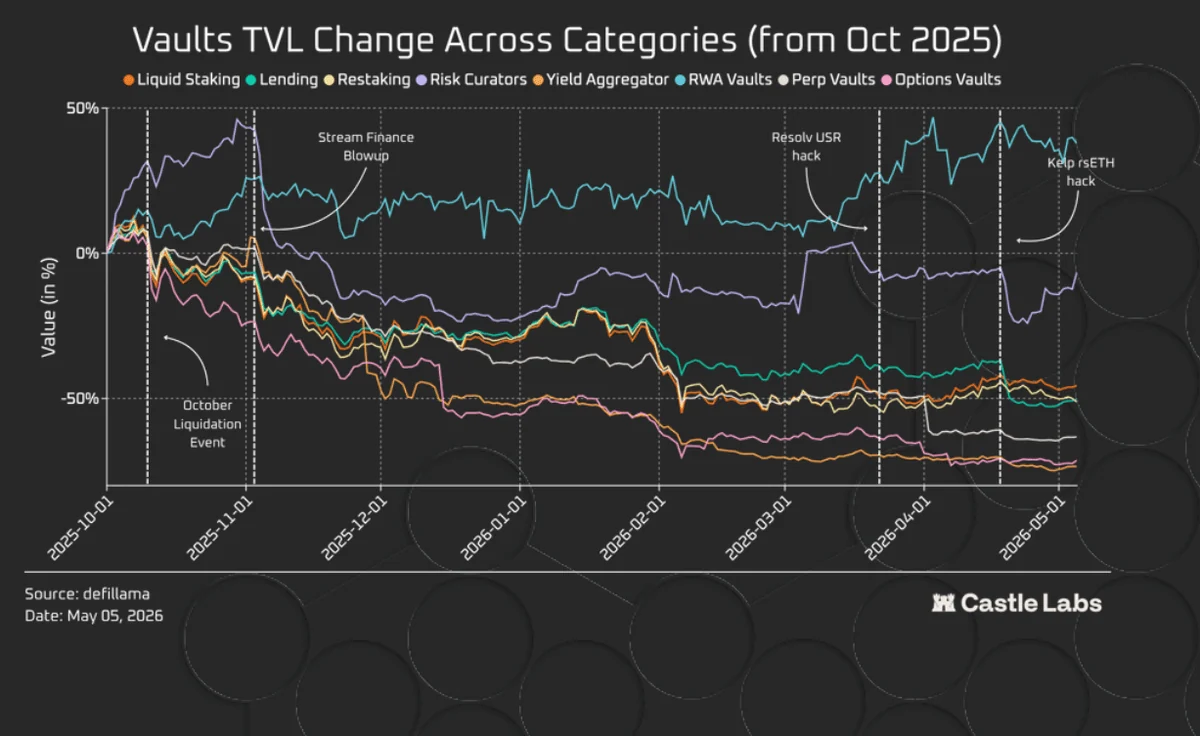
Vault TVL change by category since October 2025. Through Stream Finance, Resolv and the Kelp hack, RWA vaults gained 37.8% while every crypto-native category drew down. Their non-crypto exposure kept them uncorrelated.

Vault TVL change by category since October 2025

Through Stream Finance, Resolv and the Kelp hack, RWA vaults gained 37.8% while every crypto-native category drew down. Their non-crypto exposure kept them uncorrelated.

Report page 34

The eight vault categories, May 2026

CategoryHow it earnsLargest examples
LendingInterest from borrowersAave, Morpho ($7.5B+), Spark, Fluid, Kamino ($1.6B+)
Liquid stakingProof-of-stake rewards ($42.4B category)Lido ($21.8B), Binance Staked ETH ($8.9B), Rocket Pool ($1.2B)
RestakingExtra rewards for securing other services ($20.6B category)EigenCloud ($7.8B), EtherFi ($5.7B), Kelp DAO ($1.6B)
Risk-curatedCurator-managed lending portfolios (~$6.5B)Sentora ($1.85B), Steakhouse ($1.63B), Gauntlet ($1.5B)
Infrastructure and yield optimisersMulti-strategy allocation across DeFiVeda ($1B), Upshift ($380M), Fluid Lite ($164M)
RWA creditOffchain credit and Treasury yieldMaple ($2.1B), Centrifuge ($1.6B), Anemoy ($1.1B), Re ($263M)
Perpetual LPTaking the other side of perp tradersJupiter JLP ($715M), Hyperliquid HLP ($396M), Drift, GMX, Ostium
OptionsSelling options premium via RFQRysk (~$56M), Derive V1 vaults (~$2.4M)

Source: Castle Labs, The Vaultification of Finance (May 2026), from DeFiLlama and protocol data
What Is a Vault Curator?

A curator is the risk manager who decides where a vault's deposits go. Morpho made the model mainstream in 2024: Morpho supplies isolated lending markets and the vault blueprint, and curators choose the markets, set supply caps and rebalance. Morpho Vaults V2 splits the job into four roles (owner, curator, allocator and sentinel) and adds gating such as KYC, minimum balances and wallet-age checks.

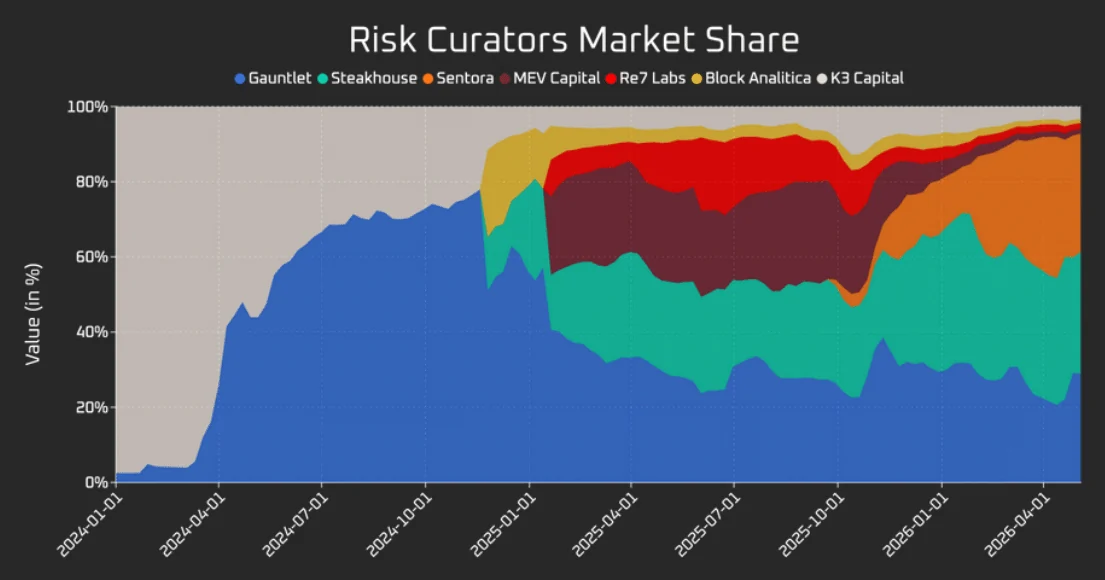
Curation is concentrated. Three curators held 75% of the ~$6.5 billion risk-curated category, and fees are far below TradFi: Steakhouse, the top curator by revenue, earned about $3 million a year on $2.13 billion of AUM, roughly 0.14%. Most curator revenue is performance-based, which rewards yield and can push allocations toward riskier markets.

Risk curator market share. Steakhouse expects concentration to follow the power laws of traditional asset management, where most assets sit with the leading managers, while the open arena keeps competition alive at the margin.

Risk curator market share

Steakhouse expects concentration to follow the power laws of traditional asset management, where most assets sit with the leading managers, while the open arena keeps competition alive at the margin.

Report page 43

Largest risk curators, May 2026

CuratorTVL
Sentora$1.85B
Steakhouse$1.63B
Gauntlet$1.5B

Source: Castle Labs, The Vaultification of Finance (May 2026)

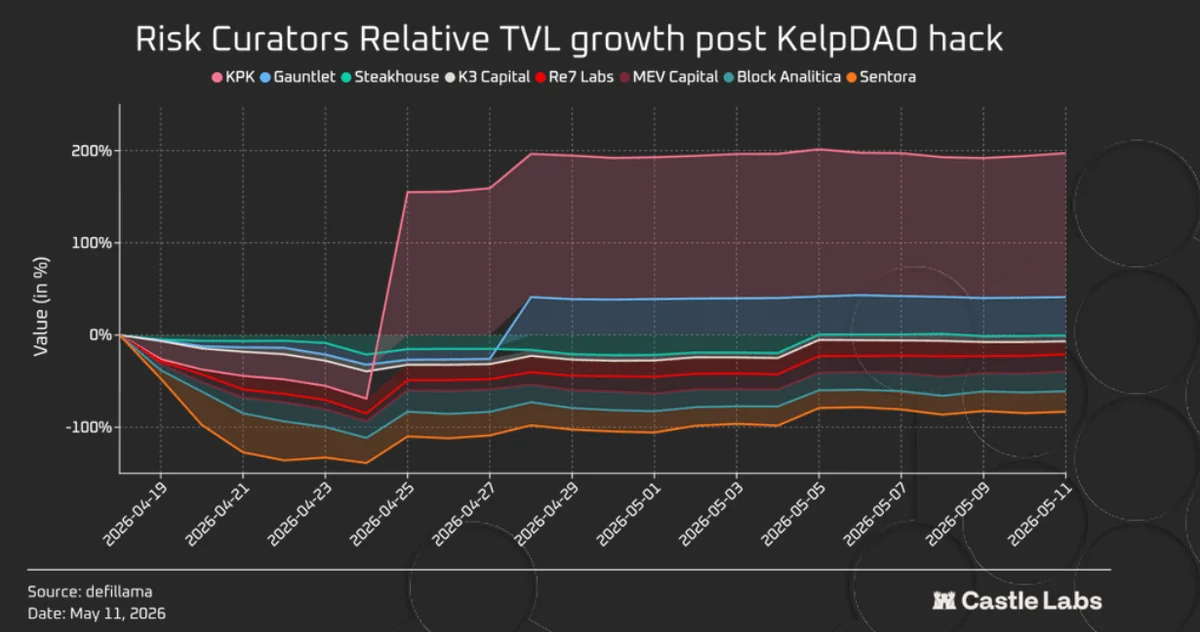
MEV Capital and Re7 peaked at $1.49 billion and $830 million before the Stream Finance collapse in November 2025. After the KelpDAO hack, KPK (+159.6%) and Gauntlet (+42.7%) still took net inflows.

Morpho vs Aave: Curated vs Pooled Lending

Aave runs pooled markets where assets share risk; Morpho runs isolated markets aggregated into curated vaults, so a problem in one market stays in that market. In the words of Morpho's co-founder, "Aave is a bank, whereas Morpho is an infrastructure for banks." Aave V4 moves toward modularity with spokes on a shared liquidity hub, but its governance still approves each spoke, while Morpho is permissionless.

The KelpDAO rsETH hack in April 2026 showed the difference. Aave lost over $12 billion of TVL and the Aave-to-Morpho TVL ratio fell from 5 to 6 times to below 2. Morpho reached over $7.5 billion of TVL, with Base growing from $604 million to over $2.8 billion, and about 40% of its USD TVL in Coinbase's cbBTC.

Morpho TVL Distribution

TVL by asset today, the ten largest and the rest

CBBTC$3.91BUSDE$760MWSTETH$606MRLUSD$559MWBTC$499MKBTC$481MUSDC$373MCIRBTC$267MPRIME$248MSYRUPUSDG$244MOthers$3.07B

Source: DefiLlama · Data to 1 Nov 2026 · Updated daily

Castle Labs
View the data
TVL
CBBTC$3.91B
USDE$760M
WSTETH$606M
RLUSD$559M
WBTC$499M
KBTC$481M
USDC$373M
CIRBTC$267M
PRIME$248M
SYRUPUSDG$244M
Others$3.07B

Now, 1 Nov 2026Morpho TVL: $11.02B · CBBTC share: 35.5%

In the report, May 2026Aave is answering on institutional rails with Horizon, which has gathered over $340 million since launch. Spark, part of the Sky ecosystem, was among the biggest winners of inflows after the rsETH hack.

Report page 36

More Charts From the Report

13 charts from the 76-page PDF on this page, each with the number that matters.

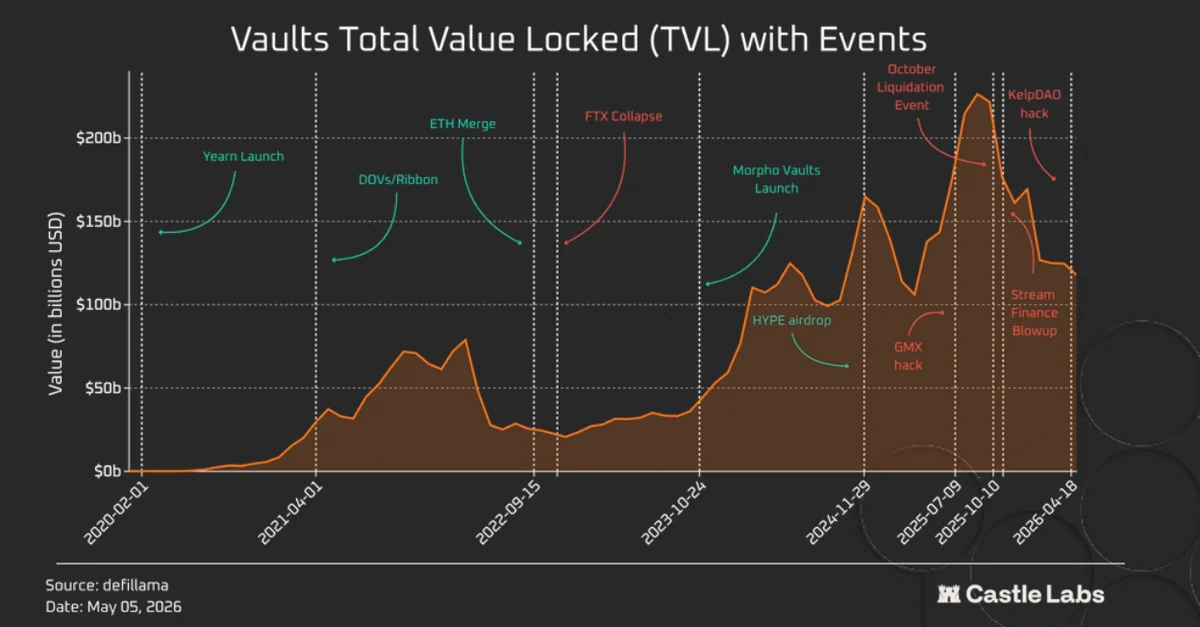
Vault TVL with key events, 2020 to 2026. Vault growth came in steps, each tied to an event: Yearn's launch, options vaults, the ETH Merge, FTX, Morpho Vaults, the HYPE airdrop, the October 2025 liquidation event, the Stream Finance blowup and the KelpDAO hack.

Vault TVL with key events, 2020 to 2026

Vault growth came in steps, each tied to an event: Yearn's launch, options vaults, the ETH Merge, FTX, Morpho Vaults, the HYPE airdrop, the October 2025 liquidation event, the Stream Finance blowup and the KelpDAO hack.

Report page 11

Vaults TVL Across Categories

Month-end TVL by vault category from January 2020, summed from the DefiLlama protocols in each category

  • Liquid Staking
  • Lending
  • Restaking
  • Risk Curators
  • Yield Aggregator
  • RWA Vaults
  • Perp and options vaults
$0$100B$200B$300B2020202220242026Report data, 5 May 2026

Source: DefiLlama · Data to Nov 2026 · Updated daily

Castle Labs
View the data
DateLiquid StakingLendingRestakingRisk CuratorsYield AggregatorRWA VaultsPerp and options vaults
Dec 2025$52.62B$54.95B$29.43B$6.43B$4.35B$2.86B$2.42B
Jan 2026$51.16B$56.36B$28.6B$7.16B$3.94B$3.21B$2.43B
Feb 2026$35.89B$45.13B$19.94B$6.57B$2.79B$2.74B$1.86B
Mar 2026$36.76B$44.42B$19.81B$7.25B$3.05B$3.77B$1.96B
Apr 2026$40.52B$36.55B$20.82B$6.96B$2.58B$3.38B$1.39B
May 2026$36.29B$36.93B$15.41B$6.93B$2.67B$3.17B$1.42B
Jun 2026$29.51B$33.13B$11.75B$7.04B$2.38B$3.43B$1.24B
Jul 2026$34.36B$37.43B$12.91B$7.93B$2.7B$3.38B$1.17B
Aug 2026$44.41B$44.6B$15.84B$8.66B$3.29B$4.18B$1.21B
Sep 2026$53.66B$51.01B$17.73B$9.49B$3.69B$3.72B$1.25B
Oct 2026$45.48B$45.9B$14.89B$9.31B$3.35B$3.17B$1.11B
Nov 2026$45.43B$46.15B$15.04B$9.34B$3.35B$3.18B$1.1B

Now, Nov 2026Liquid Staking: $45.43B · Lending: $46.15B · Restaking: $15.04B

In the report, May 2026Net TVL across the eight vault categories is $120.4 billion, down about 50% from a $241 billion peak in October 2025. The October liquidation event set off the decline.

Report page 33

EigenCloud TVL in ETH

Weekly TVL in ETH, from June 2023

0 ETH1M ETH2M ETH3M ETH4M ETH5M ETH6M ETH202420252026Report data, 5 May 2026

Source: DefiLlama · Data to week of 26 Oct 2026 · Updated daily

Castle Labs
View the data
DateTVL in ETH
10 Aug 20262.67M ETH
17 Aug 20262.65M ETH
24 Aug 20262.65M ETH
31 Aug 20262.63M ETH
7 Sep 20262.63M ETH
14 Sep 20262.62M ETH
21 Sep 20262.62M ETH
28 Sep 20262.62M ETH
5 Oct 20262.6M ETH
12 Oct 20262.59M ETH
19 Oct 20262.58M ETH
26 Oct 20262.59M ETH

Now, week of 26 Oct 2026TVL in ETH: 2.59M ETH · TVL in USD: $5.83B

In the report, May 2026EigenCloud ($7.8 billion) leads restaking ahead of EtherFi ($5.7 billion) and Kelp DAO ($1.6 billion). Its TVL held flat in ETH terms for a long time, then fell after the Kelp hack as users withdrew.

Report page 40

Risk Curators TVL

Weekly TVL of the seven curators in the report, from January 2024

  • Gauntlet
  • Steakhouse
  • Sentora
  • MEV Capital
  • Re7 Labs
  • Block Analitica and K3 Capital
$0$2B$4B$6B$8B20252026Report data, 5 May 2026

Source: DefiLlama · Data to week of 26 Oct 2026 · Updated daily

Castle Labs
View the data
DateGauntletSteakhouseSentoraMEV CapitalRe7 LabsBlock Analitica and K3 Capital
10 Aug 2026$1.42B$2.51B$1.82B$10.35M$77.83M$601M
17 Aug 2026$1.51B$2.41B$1.99B$11.95M$84.98M$638M
24 Aug 2026$1.51B$2.43B$2B$11.86M$83.1M$610M
31 Aug 2026$1.54B$2.45B$1.97B$11.08M$85.14M$563M
7 Sep 2026$1.6B$2.46B$1.95B$11.03M$86.57M$456M
14 Sep 2026$1.64B$2.52B$1.99B$11.47M$89.63M$469M
21 Sep 2026$1.62B$2.6B$2.11B$11.6M$91.82M$449M
28 Sep 2026$1.63B$2.54B$2.49B$11.52M$94.54M$431M
5 Oct 2026$1.62B$2.34B$2.56B$10.81M$62.17M$254M
12 Oct 2026$1.6B$2.5B$2.5B$10.12M$59.52M$239M
19 Oct 2026$1.64B$2.58B$2.49B$10.01M$59.19M$230M
26 Oct 2026$1.52B$2.73B$2.59B$9.68M$53.98M$220M

Now, week of 26 Oct 2026Seven curators combined: $7.13B · Largest: Steakhouse: $2.73B

In the report, May 2026Risk-curated vaults hold about $6.5 billion. Sentora ($1.85 billion), Steakhouse ($1.63 billion) and Gauntlet ($1.5 billion) manage 75% of it.

Report page 42

Curator TVL growth after the KelpDAO hack. Most curators lost deposits after the hack, but KPK (+159.6%) and Gauntlet (+42.7%) took net inflows: KPK from its new Morpho V2 vault, Gauntlet from its BSC expansion.

Curator TVL growth after the KelpDAO hack

Most curators lost deposits after the hack, but KPK (+159.6%) and Gauntlet (+42.7%) took net inflows: KPK from its new Morpho V2 vault, Gauntlet from its BSC expansion.

Report page 44

Maple Active Loans by Token

Weekly active loans by loan token, from June 2021

  • USDC
  • USDT
  • WETH
  • USDG
$0$1B$2B$3B20222023202420252026Report data, 5 May 2026

Source: DefiLlama · Data to week of 26 Oct 2026 · Updated daily

Castle Labs
View the data
DateUSDCUSDTWETHUSDG
10 Aug 2026$1.37B$418M$0$108M
17 Aug 2026$1.36B$420M$0$114M
24 Aug 2026$1.31B$401M$0$133M
31 Aug 2026$1.31B$393M$0$133M
7 Sep 2026$1.29B$335M$0$135M
14 Sep 2026$1.34B$270M$0$170M
21 Sep 2026$1.34B$244M$0$173M
28 Sep 2026$1.35B$253M$0$183M
5 Oct 2026$1.35B$274M$0$205M
12 Oct 2026$1.37B$301M$0$218M
19 Oct 2026$1.32B$320M$0$286M
26 Oct 2026$1.24B$298M$0$299M

Now, week of 26 Oct 2026Active loans: $1.83B · USDC share: 67.5%

In the report, May 2026RWA vaults grew at a 231.3% compound annual rate over five years. Maple, the largest at $2.1 billion, grew almost 10x from the start of 2025 after Syrup opened its loans to retail through syrupUSDC and syrupUSDT.

Report page 48

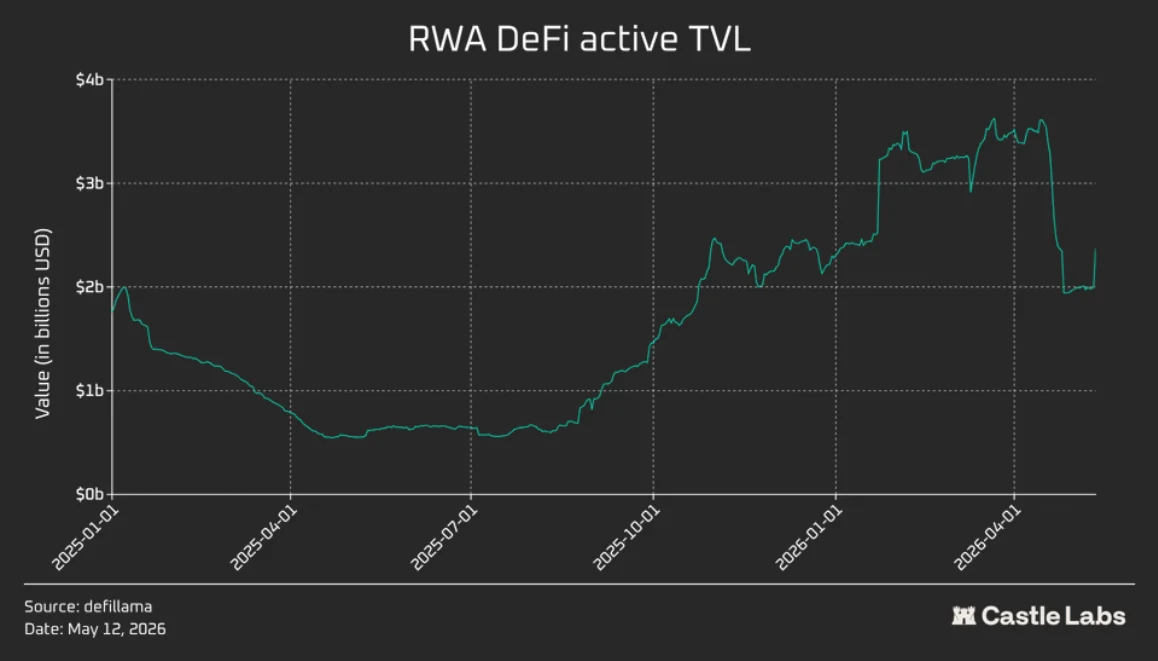
RWA TVL actively used in DeFi. Looping a 4% to 5% Treasury yield two to three times over can return 7% to 12%, but only while borrowing costs stay near 1%. Volatile stablecoin rates and slow redemptions limit how far RWAs scale in DeFi.

RWA TVL actively used in DeFi

Looping a 4% to 5% Treasury yield two to three times over can return 7% to 12%, but only while borrowing costs stay near 1%. Volatile stablecoin rates and slow redemptions limit how far RWAs scale in DeFi.

Report page 50

Hyperliquidity Provider (HLP) Vault TVL

Weekly TVL, from December 2024

$0$200M$400M$600M$800MDec '24Apr '25Aug '25Dec '25Apr '26Aug '26Report data, 5 May 2026

Source: DefiLlama · Data to week of 26 Oct 2026 · Updated daily

Castle Labs
View the data
DateHLP TVL
10 Aug 2026$187M
17 Aug 2026$188M
24 Aug 2026$188M
31 Aug 2026$189M
7 Sep 2026$187M
14 Sep 2026$188M
21 Sep 2026$183M
28 Sep 2026$182M
5 Oct 2026$180M
12 Oct 2026$178M
19 Oct 2026$175M
26 Oct 2026$169M

Now, week of 26 Oct 2026HLP TVL: $169M · Below peak: 72.2%

In the report, May 2026Perp LP vaults are led by Jupiter's JLP ($715 million), Hyperliquid's HLP ($396 million), Drift, GMX and Ostium. HLP is down 30% from its $600 million peak, and deposits follow its variable yield.

Report page 53

Ostium Liquidity Provider (OLP) Vault TVL

Weekly TVL, from July 2024

$0$50M$100MAug '24Jan '25Jun '25Nov '25Apr '26Sep '26Report data, 5 May 2026

Source: DefiLlama · Data to week of 26 Oct 2026 · Updated daily

Castle Labs
View the data
DateOLP TVL
10 Aug 2026$17.58M
17 Aug 2026$16.83M
24 Aug 2026$16.39M
31 Aug 2026$15.24M
7 Sep 2026$14.65M
14 Sep 2026$11.98M
21 Sep 2026$10.96M
28 Sep 2026$7.68M
5 Oct 2026$4.28M
12 Oct 2026$4.16M
19 Oct 2026$3.62M
26 Oct 2026$2.38M

Now, week of 26 Oct 2026OLP TVL: $2.38M · Below peak: 97.6%

In the report, May 2026OLP is down about 50% from its peak. Ostium has since made OLP a senior tranche that never takes first loss, the opposite of HLP's design.

Report page 54

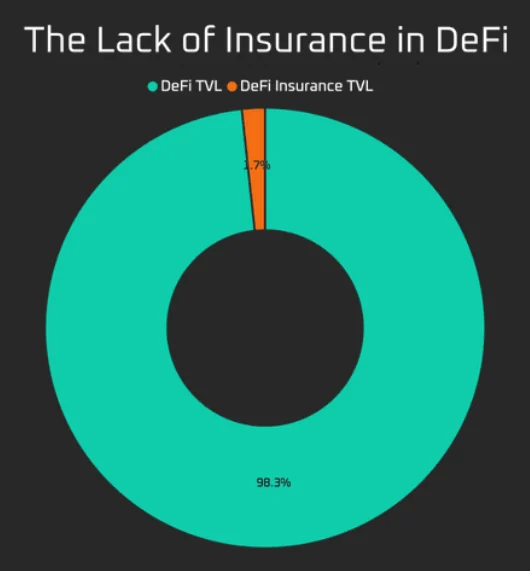
DeFi TVL vs DeFi insurance TVL. Insurance covers a sliver of DeFi: insurance TVL is 1.7% of DeFi TVL in Three Sigma's data. Vaults still lack a shared risk standard like the one ERC-4626 created for their interface.

DeFi TVL vs DeFi insurance TVL

Insurance covers a sliver of DeFi: insurance TVL is 1.7% of DeFi TVL in Three Sigma's data. Vaults still lack a shared risk standard like the one ERC-4626 created for their interface.

Report page 69

Get every chart in the full report →

Method and Data Boundary

Castle defines a vault as an instrument through which users access an active yield-generating strategy. Pure wrappers of offchain assets are excluded. The report groups qualifying products into eight categories and compares TVL, curator concentration, stress performance and risk design.

Published
May 2026
Data snapshot
May 2026

Data From the Report

Major vault incidents and what they exposed

Incidents covered in the report, 2022 to 2026.

IncidentDateWhat happenedRisk it exposed
Venus donation attack (zkSync)March 2025About $700K of wUSDM exploited by inflating an ERC-4626 share priceSmart contract
JELLY on Hyperliquid HLPMarch 2025Manipulated memecoin position forced onto HLP; manual delisting avoided a loss of more than $13MCounterparty
Stream Finance xUSDNovember 2025$93M loss; oracle kept xUSD at $1 while it traded 70-80% lower, blocking liquidationsOracle and liquidity
Aave wstETH oracleMarch 2026A 3.3% oracle gap liquidated 34 healthy accounts for $27.78M in one blockLiquidation
Resolv USRBetween Oct 2025 and May 2026About 80M unbacked USR minted; bad debt hit 15 Morpho vaults (~$10M) and Fluid (~$21M)Oracle
KelpDAO rsETHApril 2026Contagion through Aave looping; Aave lost over $12B of TVLRehypothecation and contagion

Source: Castle Labs, The Vaultification of Finance (May 2026)

Questions This Report Answers

How much is locked in DeFi vaults?
$120.4 billion of net TVL across eight vault categories in May 2026, down about 50% from a $241 billion peak in October 2025. The figure is higher than DeFi's total TVL of about $86 billion because vaults stack: stETH from a liquid staking vault is reused as collateral in lending vaults.
Which vault category held up best in the 2025-2026 sell-off?
RWA vaults. From October 2025 to May 2026, through the Stream Finance, Resolv and KelpDAO incidents, RWA vaults grew 37.8% while every other category fell, because their yield comes from offchain credit and Treasuries rather than crypto collateral. RWA vaults have grown at a 231.3% compound annual rate over five years.
What is ERC-4626?
ERC-4626 is the tokenised vault standard, proposed in December 2021 and live since March 2022. It gives every vault the same share-token interface (deposit, mint, withdraw, redeem and conversion functions), so protocols integrate one standard instead of writing an adapter per vault. ERC-7540 extends it with request-then-claim settlement for assets that cannot settle in one transaction.
Who are the largest vault curators?
Sentora ($1.85 billion), Steakhouse ($1.63 billion) and Gauntlet ($1.5 billion) held 75% of the roughly $6.5 billion risk-curated vault category in May 2026. Curators charge far less than TradFi funds: Steakhouse earned about $3 million a year on $2.13 billion of AUM, around 0.14%.
How do institutions use DeFi vaults?
Mostly through vault infrastructure rather than directly. Bitwise became a Morpho curator in January 2026; Kraken DeFi Earn, powered by Veda, took $200 million of deposits in two weeks; Coinbase uses Morpho for over $1 billion of BTC-backed loans; and Aave's institutional market Horizon has drawn over $300 million. Institutions want isolated risk, independent verification and compliance built into the vault.
What are the main risks of DeFi vaults?
Seven recur: smart contract risk across the vault, base protocol and markets; curator risk; rehypothecation and contagion; counterparty risk; oracle failures; liquidity risk when markets hit 100% utilisation; and liquidation risk from oracle lag or cascades. Stream Finance's xUSD showed several at once: its oracle held a $1 price while the token traded 70-80% lower, blocking liquidations and leaving bad debt.
How does RWA looping work?
A looper borrows stablecoins against tokenised Treasuries and redeposits them into the yield vault several times. A 4-5% Treasury yield looped 2-3 times can return 7-12%, but only while borrowing stays cheap, around 1%. The catch is exit time: with a 5x loop on an asset that redeems in two days, fully unwinding can take up to 10 days.