Prediction markets as option-like instruments
This article is an excerpt from our research on The Renaissance of Onchain Options, mapping the expansion of options (and prediction markets) as a trading instrument and the volatility that prices them, published in collaboration with BlockScholes.
Download the complete report here.
Prediction Markets (PMs) closely resemble traditional binary options.
In binary options, users choose either a call (buy) or a put (sell), predicting whether the asset’s price will be higher or lower than the strike price at expiration. This is the same mechanism on which PMs function. These are simpler instruments than the options because a trader is essentially betting on the asset’s price and whether it will be above or below a certain level.
Prediction markets take the traditional binary options one step further by introducing ultra-short-expiration markets, with times as short as 300 seconds. Additionally, the rules are simple: either the value of your “Yes” or “No” share approaches $1 or $0.
These markets have attracted significant attention and are today major contributors to trading volume on platforms like Polymarket and Kalshi.
Moreover, PMs as a whole are growing at an enormous rate and have consistently driven monthly volumes exceeding $30 billion over the past two months. Last month (i.e., June 2026), it even surpassed $45 billion, given the World Cup-related trades on the platform.
In this section, we highlight the protocols driving this growth, how they function, how they compare in terms of the volumes they handle, the infrastructure supporting them, and how these platforms are evolving to replace traditional instruments to some extent.
We also went live with different builders to discuss the options market, including guests from Kalshi, Rysk, and GammaSwap.
Standalone prediction-market venues
Polymarket
Polymarket’s settlement infrastructure runs on Polygon PoS and utilises Gnosis’s Conditional Token Framework to create a binary outcome contract. For liquidity, the platform relies on a hybrid CLOB-based model, and users (market makers) are incentivised to provide liquidity.
Resolution path is an important factor for any PM: Polymarket sources its event resolution from the combination of UMA’s Optimistic Oracle and Chainlink for crypto price markets.
Regulatory alignment remains pivotal for expanding into multiple regions: In 2022, the platform received a CFTC order and was unable to provide access to U.S. customers. To reclaim this market, the platform acquired QCEX (a CFTC-licensed DCM) in 2025 to reenter the U.S. market. They are currently slowly rolling out Polymarket U.S.
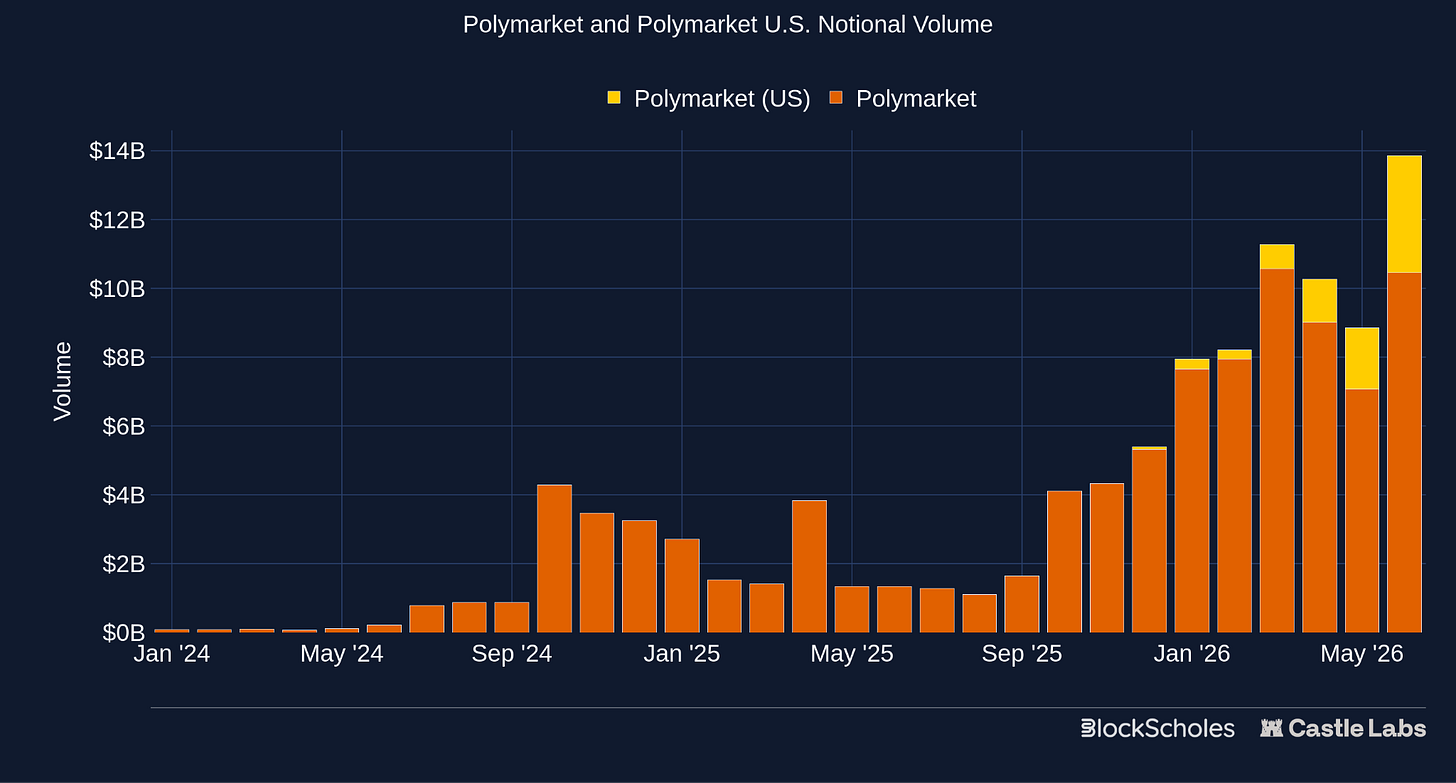
The platforms’ monthly volume now exceeds $10 billion, primarily driven by categories such as crypto, sports, and politics.
PMs’ crypto markets attract a ton of volume, as they offer a simpler design and appeal to audiences interested in trading binary options with ultra-low expiry time. Users can buy a simple “Yes” or “No” contract on whether the price of an asset like BTC will be above or below a certain number after 5 minutes, 15 minutes, 1 hour, and so on.
These markets are created automatically after the designated market period and are also referred to as “digital binary options” because of the fixed expiration time and binary payout structure, which settles at either $0 or $1.
Regarding options-related markets, Polymarket also went live with Volmex Volatility Index markets, which track the IV of crypto assets such as Bitcoin. However, these markets failed to attract much volume because there is a steeper learning curve to trade in such markets.
This makes the case for how PMs find PMF as a seamless instrument, abstracting the complexity of outcome events and gaining volume in simpler categories that require users to choose between two options, rather than in multi-outcome events that add complexity. Additionally, it highlights the divergence in audience between traditional derivative trading platforms and PMs, as the latter’s market structure is easier to understand and has a low barrier to entry.
Kalshi
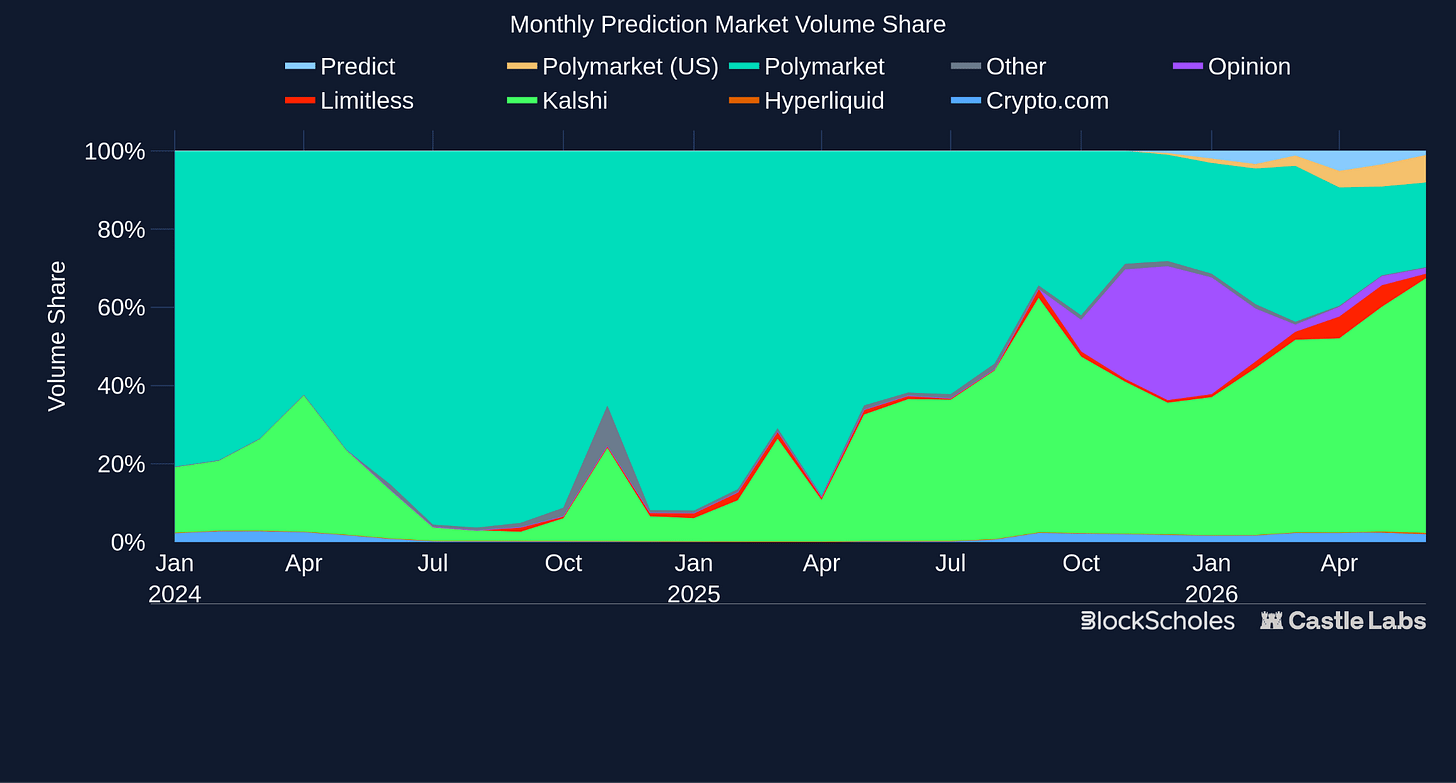
Kalshi commands over 65% of the volume in prediction markets and has slowly outpaced its competitor, Polymarket. At one point, both platforms were trading at similar valuations, but now Kalshi is eyeing $40 billion, while Polymarket is targeting $15 billion for its next round. The gap between them widened primarily due to Kalshi’s regulated approach, its dominance in the U.S., and its collaboration with platforms like Robinhood.
Similar to Polymarket, Kalshi also offers 5-minute and 15-minute crypto markets, making it more tied to binary options. Their liquidity sourcing model is also similar, based on a CLOB, while Kalshi has ties with institutional market makers.
Additionally, both Polymarket and Kalshi are launching their perps platform. Kalshi recently went live with it, becoming the first federally regulated perpetual futures trading platform in the U.S. It is currently making its way into the category and has reached daily perps volume of $1 billion, with OI growing steadily as well.
Limitless
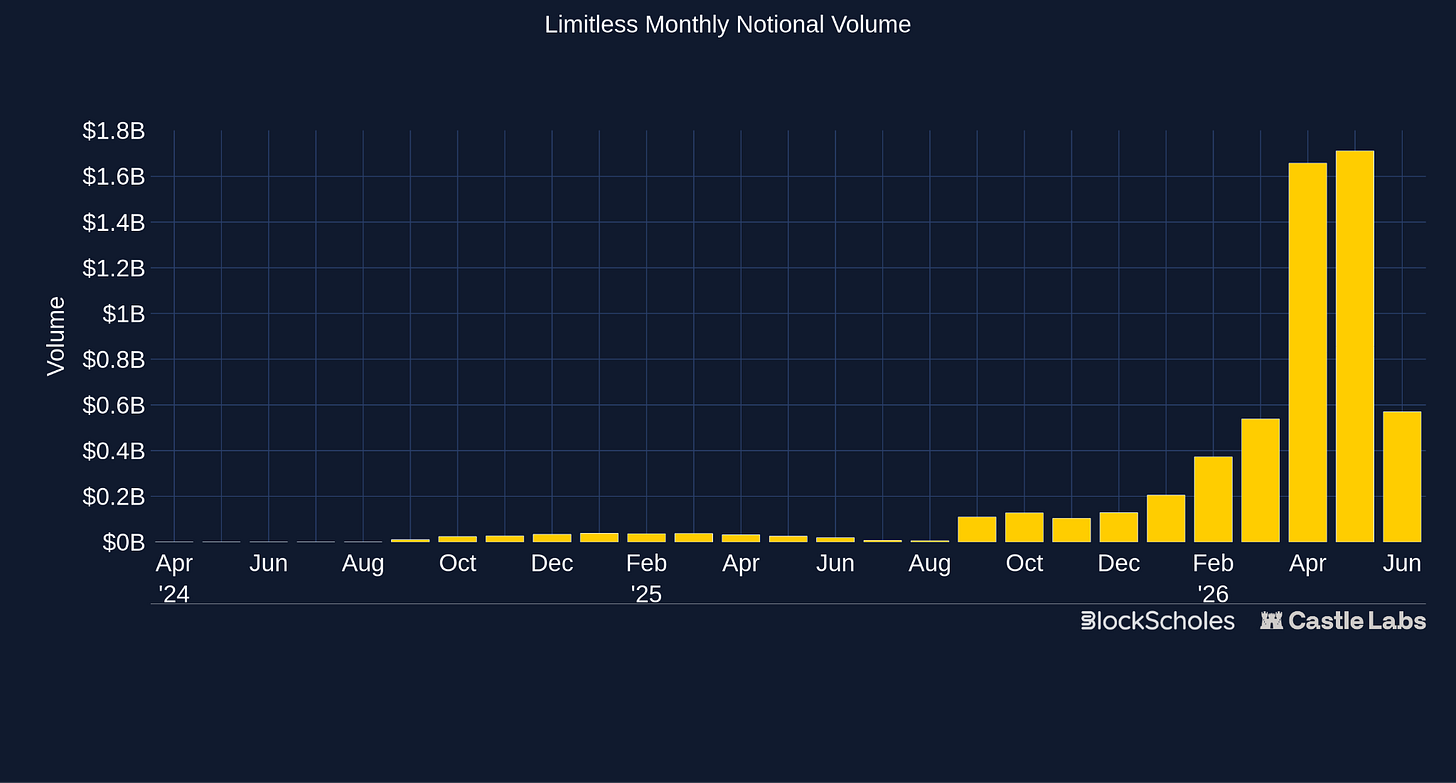
While most of the volume is driven by top products like Polymarket and Kalshi, a few products, such as Limitless, are also making their space in the category. They are one of the few products with a live token and have recently expanded their offerings through user-generated markets (UGMs), which enable users to create financial markets in a permissionless manner.
Structurally, Limitless is similar to Polymarket and Kalshi and offers comparable offerings, but their recent expansion into UGMs for crypto positions them differently. If UGMs can scale, they can become a custom binary option-like hedge instrument, where users can choose the price at expiry rather than have it set by the platform. Once they introduce other asset classes, such as stocks and commodities, the use cases could grow. This asset class expansion also applies to other PMs.
Predict.fun
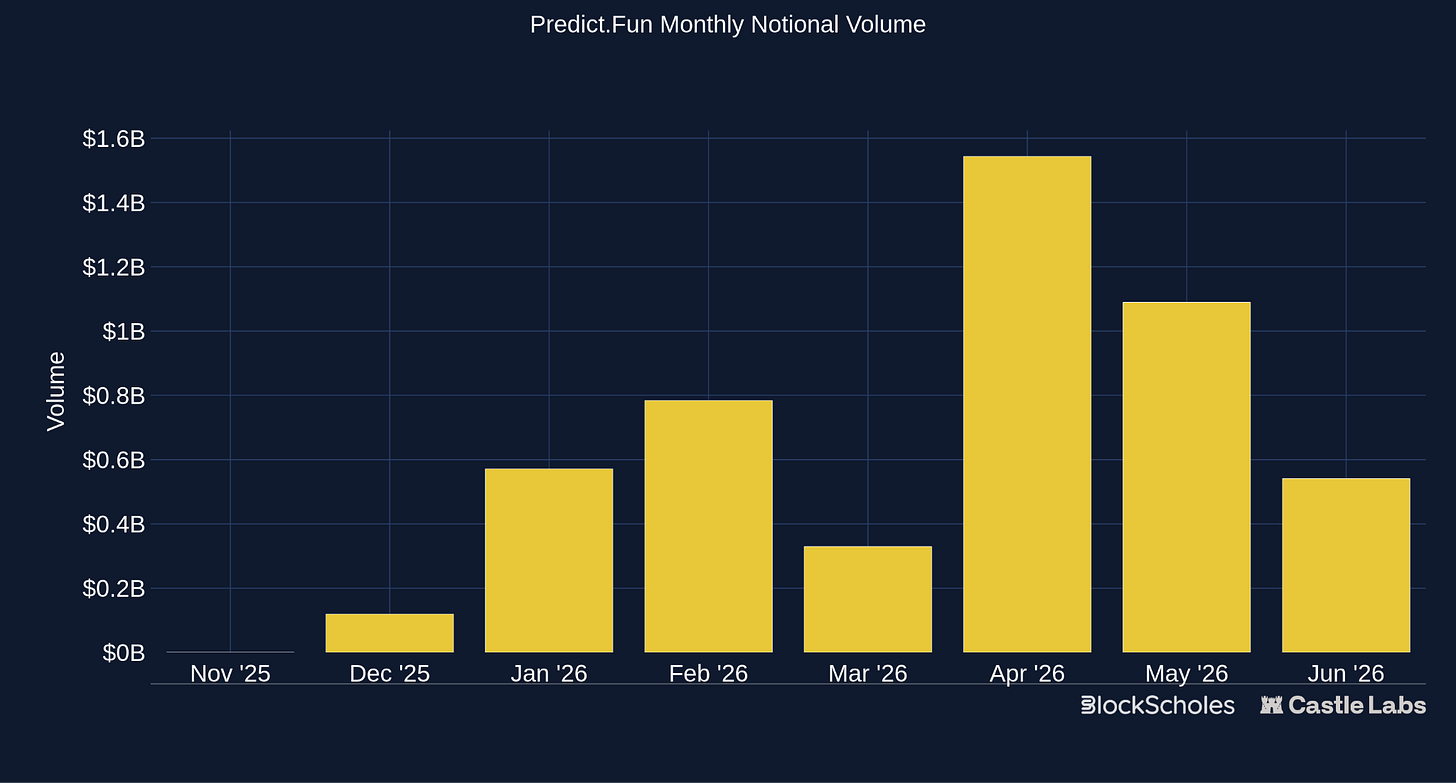
Predict.fun offers a unique twist on PMs, allowing users to earn lending yields while their positions are active. These yields come from their integration with Venus Protocol on the BNB chain; the collateral deposited to purchase the contracts is deployed in the lending protocol to earn base stablecoin yields (3-5%).
This feature is something only onchain prediction markets can enable. Suppose a user has an active hedged position on such a platform, and while they are hedging, they could also earn yield, which could effectively contribute to the overall position PnL.
Deepbook Predict
Deepbook Predict is currently in whitelist mode and is developing on Sui. It is part of the expanding Deepbook Stack, which includes Spot and Margin products. Predict is where binary markets live, and because it is composable with other Deepbook products, a Predict position can be leveraged or used as collateral, making it a distinct offering from incumbents like Polymarket and Kalshi, whose positions have no additional utility.
Liquidity in these markets is sourced from LPs who deposit their assets in a shared vault, which is used to take the opposite side of traders. Depositors receive a PLP token receipt and earn interest from fees or from traders who lose bets. What sets Deepbook apart is its oracle infrastructure, as its binary outcome products reference Block Scholes, which prices binaries from a full implied-volatility (IV) surface.
PM, as a category, is consistently expanding, with newer products taking different approaches, such as offering UGMs, robust resolution infrastructure, and improved capital efficiency.
In the section that follows, we cover newer offerings that take a whole different approach to prediction markets by embedding them in their existing products.
Embedded prediction-market primitives
HIP-4 went live in May 2026 and has amassed over $250 million in volume so far.
Hyperliquid’s offering is structurally different from others because it is already a well-established perpetual exchange doing billions in daily trading volume. Under the same margin account used on the perp exchange, users could access the binary outcomes offered through HIP-4, which has provided a good distribution flow from Day 1, making Hyperliquid a strong competitor to existing incumbents. Additionally, users gain exposure to options-style payoffs and hedges alongside their existing perpetual positions, enabling different strategies.
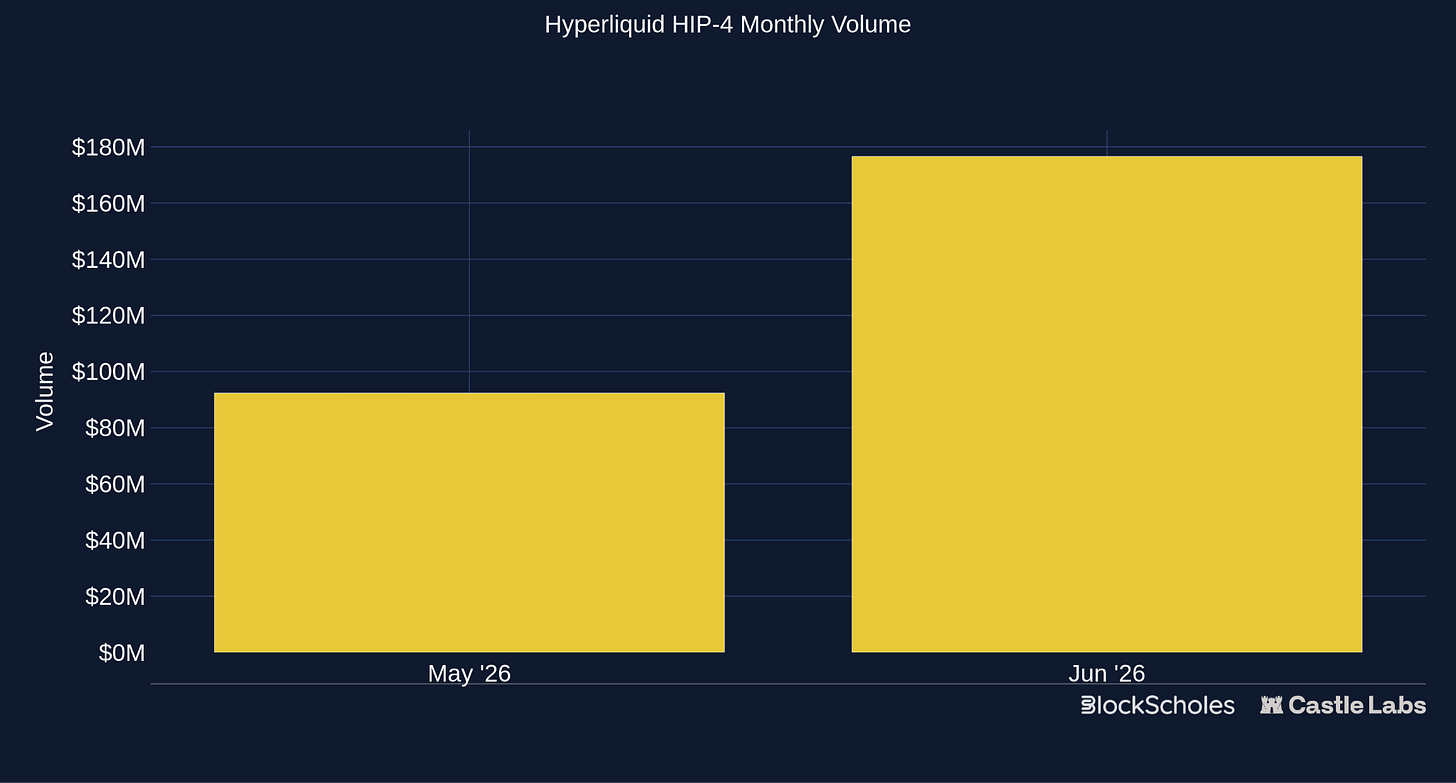
To launch these markets, deployers need to stake 1M HYPE (~$60 million), thereby providing a sufficient barrier to entry and maintaining market quality. Currently, markets are covering Crypto, Sports, and Economics.
Additionally, Hyperliquid is the cheaper venue for trading smaller-sized positions (due to less liquidity currently). It charges fees only at closing or settlement, not at opening; the fees are 7 bps for taker and 4 bps for maker.
In the next section, we compare binary options providers, evaluating their trading volume, spreads, and performance over the last 1 week to determine which platforms currently lead in the binary options market.
Comparing Binary Options Providers
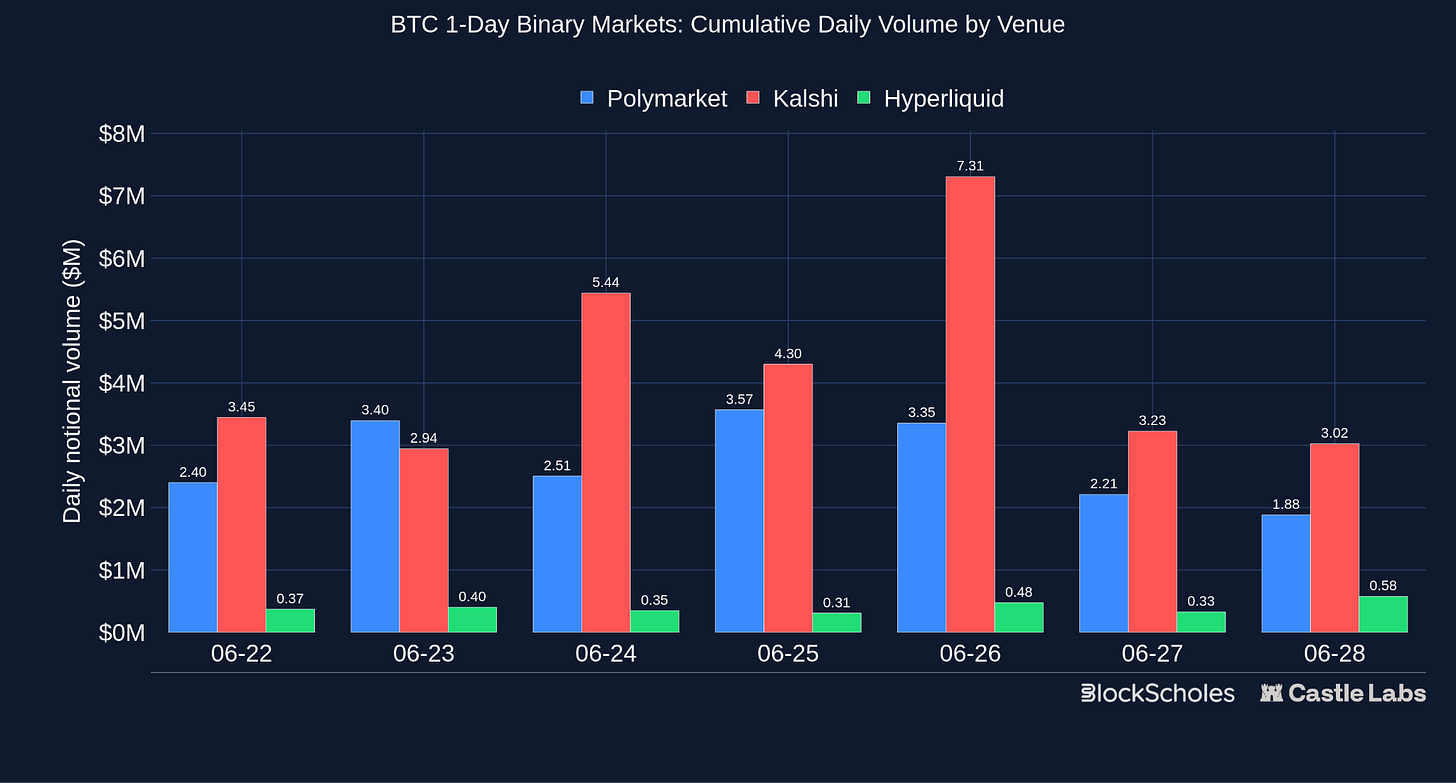
In this section, we compare the top providers for binary outcomes, including Kalshi, Polymarket, and Hyperliquid, based on the volume and spread of the BTC 1-day expiry markets they list, using data from the past 1 week (2026-06-22 to 2026-06-28).
The goal of this analysis is to quantify the quality of these different trading venues for binary-outcome markets, map the performance of a common offering (the BTC 1-day market), and assess how newer participants like Hyperliquid are catching up.
Data Methodology
All these venues share a similar goal with this offering: a binary “above/below a fixed BTC price” market expiring in 24 hours, but they differ significantly in practice.
For BTC specifically, Hyperliquid lists exactly one 1-day binary market per day (its HIP-4 outcome markets also list many non-crypto markets mainly around economics and sports). Polymarket and Kalshi (KXBTCD) both list a ladder of multiple markets within these 1-day markets at different strike prices.
To perform this research, we mainly compare:
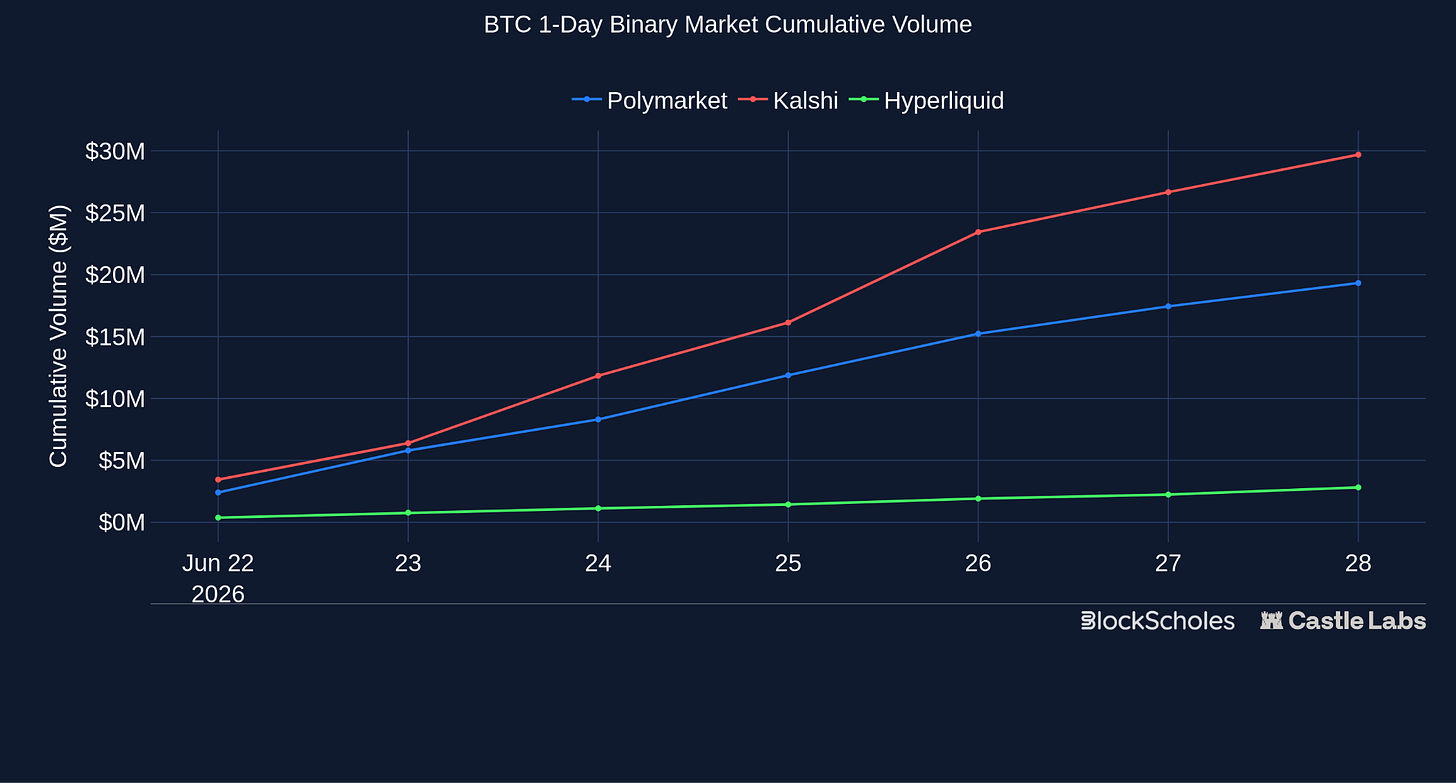
Volume: Cumulative volume summed across each venue’s entire strike ladder within our data window.
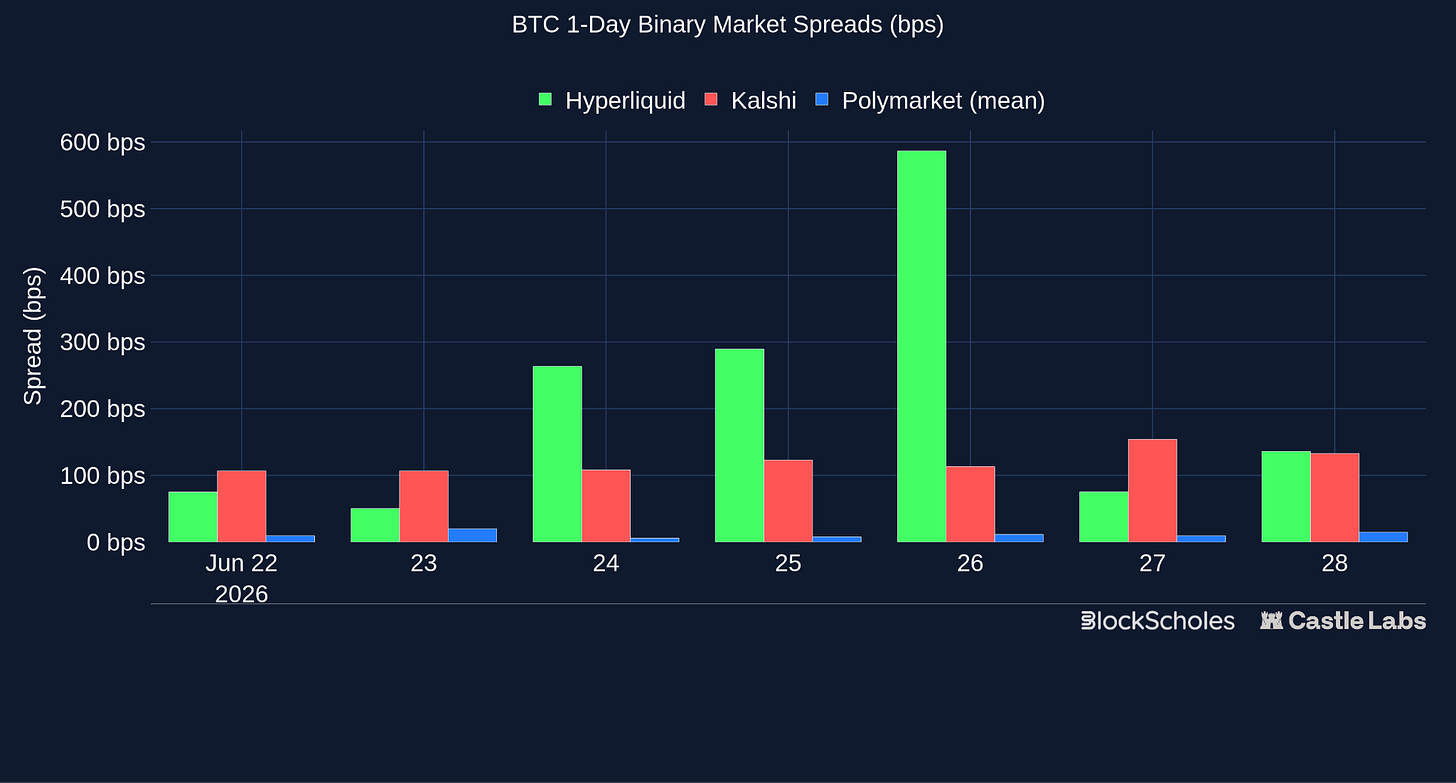
Spread: The gap between the best bid and ask at each day’s highest-volume (deepest market in the ladder for Polymarket and Kalshi) strike. Each platform’s spread is calculated differently: Hyperliquid’s spread is the mean of orderbook snapshots sampled a few times throughout the day; Kalshi’s spread is the mean bid-ask gap from 1-minute candlesticks in the hour before close; Polymarket’s spreads are fetched from reconstructed historical trade execution prices.
We source this data from multiple sources: for Hyperliquid, we use the 0xarchive API; for Polymarket and Kalshi, we use their public REST APIs (Polymarket’s Gamma/CLOB/Data APIs and Kalshi Trade API).
The Analysis
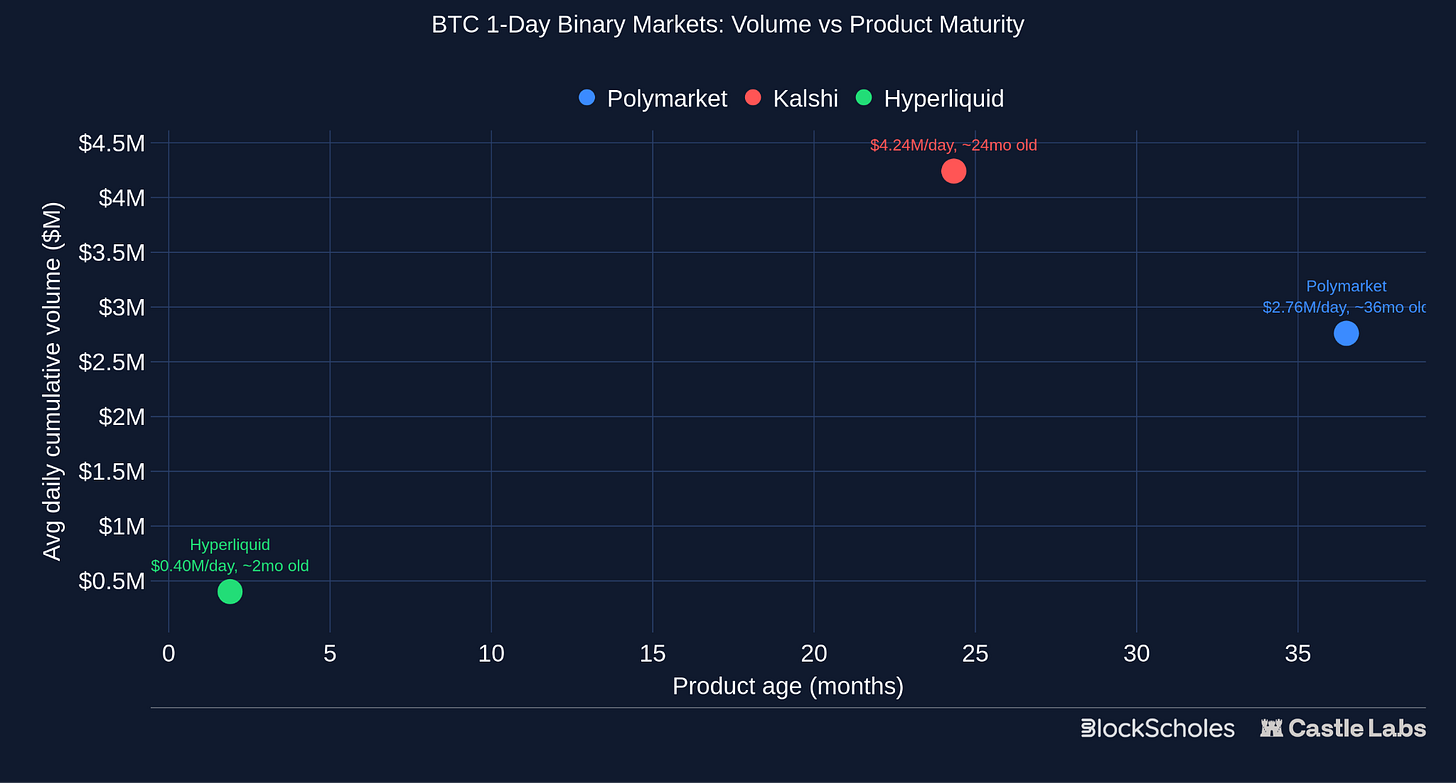
Within the observed window, Kalshi’s volume for the BTC 1-day binary market is the highest, averaging $4.24 million, compared to Polymarket at $2.76 million and Hyperliquid at $400k. This reflects only the BTC 1-day binary specifically; this ranking might vary across different categories.
Spreads, on the other hand, have a different trajectory. Hyperliquid, the lowest-volume venue, also had the widest and most volatile quoted spread (50-587 bps, spiking near settlement on one day); Kalshi held a steadier 107-154 bps band despite having the highest volume. Polymarket’s reconstructed spread (5.8-19.8 bps) is the tightest of the three despite lower volume than Kalshi.
Note on Polymarket Spread: Polymarket’s spread is estimated from actual trades rather than read directly from a live order book, which can make it appear artificially tight. The reason: once BTC moves clearly above or below the strike, the outcome becomes near-certain, the YES or NO token converges toward $1 or $0, making the spread we reconstruct from trades at that point compress toward zero. In a one-day market, this phase often dominates in our data, making the median reconstructed spread for Polymarket 0 bps on almost every day, even if the mean isn’t. Additionally, there may be other reasons why Polymarket’s spreads appear tighter, including market-maker incentives or automated trading activity, but we haven’t examined these in this research.
Comparing protocol offerings by age makes the distinctions in volume and spread concrete, as Polymarket and Kalshi have offered binary markets longer than Hyperliquid; both platforms’ volume and spreads are generally better due to already-developed liquidity for this market type.
Over the duration of the analysis, the 1-day BTC market has accounted for $29.6 million, $19.3 million, and $2.8 million in volume for Kalshi, Polymarket, and Hyperliquid, respectively.
Resolution and Oracle Infrastructure
A prediction market, or a binary outcome, is as good as its market-resolution mechanism. There are several different oracle mechanisms, but they can be broadly divided into three categories:
Decentralised Oracles: Polymarket uses a UMA Optimistic oracle and follows a propose-then-dispute model. Market participants can dispute any decision made by UMA voters within 48 hours of the proposal; if it passes the voting process again, it is accepted. But this model has flaws that have surfaced multiple times because UMA voting power is highly concentrated among a few whales, who try to steer the market for their own profit, as seen in recent instances such as the Strategy BTC Sale Market.
Centralised Oracles: These oracles are labelled centralised and used by platforms such as Kalshi and Limitless, which have internal teams that make market decisions. It has so far proven better than decentralised Oracles like UMA, as Kalshi hasn’t had any major reported instances of people losing money due to a poor resolution mechanism like UMA.
Automated Oracles: These include Chainlink and Pyth, which provide crypto price data to DeFi platforms. They are used by almost every platform that offers automated crypto markets. They don’t introduce any problems, usually because they simply report the asset’s actual price, which is often verified by validators. Apart from them, BlockScholes is another contender on the list, which, in addition to the spot price, also streams a full volatility surface, allowing the protocol to continuously compute the fair value of binary outcomes.
There are a few unique resolution models as well, such as the one used by XO Market, a permissionless prediction market. They have a three-layer resolution system. The first is the AI-first path through MODRA (Market Outcome and Dispute Resolution Agent), which uses AI to autonomously resolve clear-cut cases quickly. After that comes the Senate court and a Supreme Court appeal, which require human review. It has traded over $250 million so far, enabling 2800+ markets and 30,000+ trades.
Apart from this, protocols like Augur are also working on the resolution infrastructure as part of their updated roadmap under the Lituus Foundation. In their new resolution engine, participants commit their own capital in support of an outcome. Every time a dispute occurs, the commitments increase, making it progressively more expensive to sustain a dishonest position.
While there has been great work in this category, the top protocols still face challenges due to the oracles they utilise; only once they move to better oracles or improve the current ones could the category improve.
Additionally, in the context of the report, for automated crypto markets that correlate with binary options, providers like Chainlink and Pyth are used to minimise resolution risk.
Closing Thoughts
PMs in the last 18 months have grown from a ~$2 billion/month category to a ~$30 billion/month category. The majority of this growth occurred after the 2024 U.S. elections, during which Polymarket posted odds more accurate than those implied by traditional polling methods.
Polymarket’s crypto volume grew rapidly after it launched 15-minute and 5-minute markets, during the period from Q4 2025 to Q1 2026. These markets are similar to binary options, as traders could simply buy a “Yes” or “No” contract priced between $0.01 and $0.99 and would know exactly how much they would win if the market resolved in the direction of their position. These markets ultimately gave rise to multiple strategies that sought to exploit their inefficiencies, whether by exploiting latency arbitrage between price movements and oracle updates or by securing equal market shares at a discount, bringing the total value to $1.
Additionally, as they grew, Polymarket introduced fees on these markets and slowly rolled them out to other categories as well. Nonetheless, these markets proved to be a great short-term expiry instrument for traders who are highly invested in them, as volumes continue to rise.
This growth is also aligned with the increasing contribution in options volume from 0-day expiry options (0DTE) and short-dated options. For option buyers in this category, PMs’ crypto markets offer even shorter expirations than traditional venues, making them attractive.
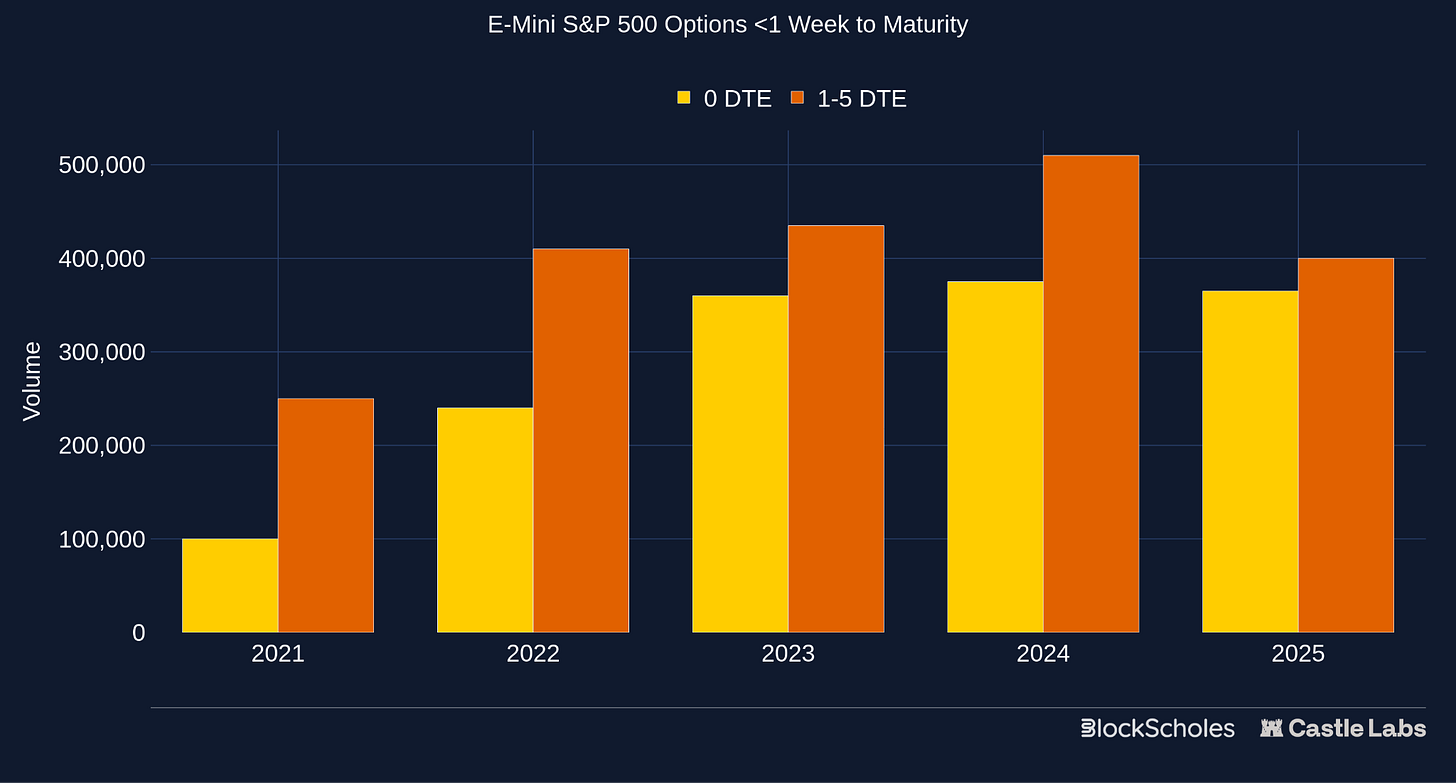
Source: https://www.cmegroup.com/articles/2026/explore-the-benefits-of-short-dated-options.html
In terms of fees, PMs as a category generated over $300 million this month (i.e. June 2026), primarily led by Kalshi and Polymarket. For reference, this is almost double the fees of categories like Lending, making it attractive in terms of revenue as well.
PMs, as a category, have already moved towards mainstream adoption. With offerings like binary options on various crypto assets, they are also close to the traditional options market.
As they grow, the gap between traditional venues and PMs is expected to close due to simpler design choices by these platforms and good UX.
This article is an excerpt from our research on The Renaissance of Onchain Options, mapping the expansion of options (and prediction markets) as a trading instrument and the volatility that prices them, published in collaboration with BlockScholes
Download the complete report here.
Originally published in the Castle Labs newsletter. Subscribe at research.castlelabs.io/subscribe.